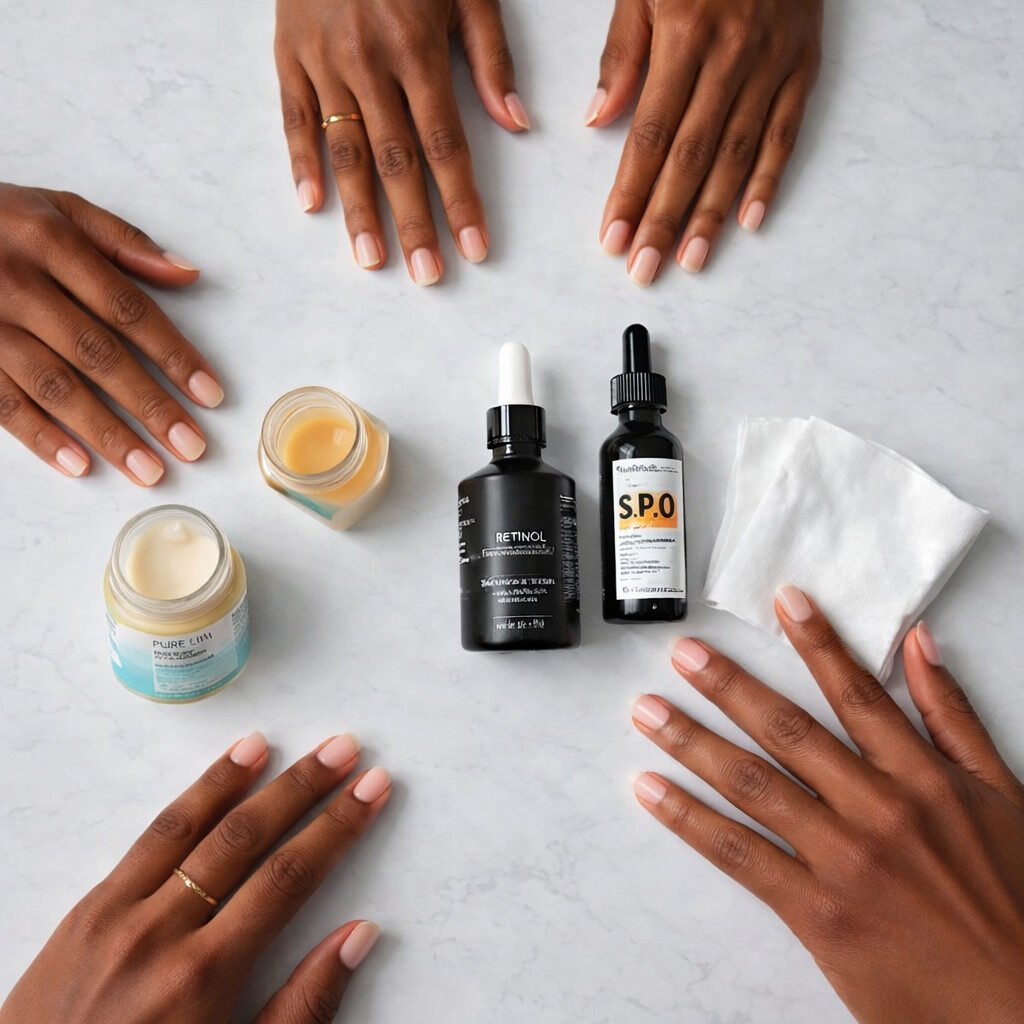
Beginners should proceed cautiously with retinol; I explain how you can pick safe, effective options for melanin-rich skin. I advise you to start with low concentrations, perform a patch test, and use sunscreen daily to avoid the risk of irritation and post-inflammatory hyperpigmentation. I highlight products with supportive ingredients like ceramides and niacinamide and the potential for gradual improvement in texture and discoloration when used correctly.
Key Takeaways:
- Start with low concentration and frequency – e.g., 0.25-0.3% retinol, applied 1-2 nights/week and gradually increased as tolerated.
- Choose gentle formulations (encapsulated retinol, retinaldehyde, or low-strength retinyl esters) or consider bakuchiol if skin is very reactive.
- Prioritize barrier-repair and soothing ingredients (ceramides, glycerin, squalane, niacinamide) and avoid fragrances and drying alcohols.
- Use daily broad-spectrum SPF 30+ and sun-protective measures to minimize risk of hyperpigmentation.
- Patch test and introduce one product at a time; stop if persistent irritation or new dark spots appear and consult a dermatologist if needed.
- Avoid retinoids during pregnancy and breastfeeding.
- Expect gradual improvement over 8-12+ weeks; introduce brightening actives (vitamin C, niacinamide, azelaic acid) slowly to help fade hyperpigmentation.
Understanding Retinol and Its Benefits for Melanin-Rich Skin
I explain how retinol accelerates cell turnover to smooth texture, fade dark spots, and boost collagen, often showing visible improvement in 8-12 weeks; for melanin-rich skin this means targeted reduction of hyperpigmentation but also a higher risk of irritation-driven post-inflammatory hyperpigmentation, so I advise starting low, spacing applications, and pairing with consistent sunscreen and barrier support to protect results.
What is Retinol?
I describe retinol as a vitamin A derivative available OTC that converts to retinoic acid in the skin, regulating keratinocyte turnover and collagen synthesis; typical OTC strengths range from 0.01% to 1%, and I often recommend beginners try 0.025%-0.05% for 4-8 weeks before increasing to limit irritation while assessing tolerance.
How Retinol Works on Skin Types
I observe that retinol promotes epidermal renewal and reduces melanin transfer, which helps fade dark spots, but if you overuse it you can trigger inflammation and post-inflammatory hyperpigmentation in deeper phototypes; I usually suggest alternate-night use, buffering with moisturizer, and sun protection to maximize benefits and minimize risk.
- retinol strength: start low (0.025%-0.05%)
- frequency: alternate nights, then increase
- barrier support: use emollient moisturizers and humectants
- sunscreen: SPF 30+ daily to prevent rebound pigmentation
- Assume that you will need 8-12 weeks to gauge visible change and adjust accordingly
| Starting concentration | 0.025%-0.05% for beginners |
| Initial frequency | Every 2-3 nights, then increase |
| Buffering option | Apply moisturizer before/after to reduce irritation |
| Common side effects | Dryness, flaking, mild redness |
| When to consult | Prolonged inflammation or worsening pigmentation |
I expand that when I tailor regimens for different skin types, I often set specific timelines: for example, I put clients with melanin-rich skin on 0.025% for 6-8 weeks then reassess; if tolerated, I move to 0.05% or increase frequency, while monitoring for any inflammation because even brief irritation can cause post-inflammatory hyperpigmentation-I prioritize slow progression and daily sunscreen.
- patch test: test a small area for 3-5 days
- titration: increase strength or frequency gradually
- moisture layering: use occlusives at night if flaking occurs
- professional guidance: seek a dermatologist for persistent issues
- Assume that managing irritation is the fastest route to safe, lasting results
| Oily skin | Start 0.025% every other night; increase as tolerated |
| Dry skin | Buffer with moisturizer; consider 0.01%-0.025% |
| Combination skin | Spot-treat oilier areas; hydrate drier zones |
| Sensitive skin | Use lowest strength, 1-2x weekly then titrate |
| Melanin-rich skin | Start low, monitor for PIH, prioritize sunscreen |
Choosing the Right Retinol Product
When identifying a formula I prioritize gentle, well-formulated options that support your skin barrier; for beginners I recommend starting with 0.25-0.3% retinol in a cream or encapsulated serum, fragrance-free and paired with ceramides or hyaluronic acid to reduce irritation. I advise patch testing for 24-48 hours, avoiding alcohol-heavy or exfoliant-packed hybrids, and committing to daily sun protection-broad-spectrum SPF 30+-since irritation can provoke hyperpigmentation in melanin-rich skin.
Key Ingredients to Look For
I look for ingredients that blunt retinol’s irritation while helping fade dark spots: niacinamide (2-5%) to reduce pigment transfer, ceramides and fatty acids to restore barrier function, and hyaluronic acid for hydration. Antioxidants like vitamin E help stabilize formulas; however, I recommend separating high-strength vitamin C (10-20%) from nightly retinol to minimize sensitivity unless advised otherwise.
Potency Levels for Beginners
For most skin types I recommend beginning with very low strength: 0.25-0.3% retinol, applied 1-2 nights per week and increased slowly as tolerated; after about 8-12 weeks you can consider 0.5% if no persistent irritation occurs, while 1% should be reserved for experienced users. I always advise a 24-48 hour patch test and stopping at first sign of active inflammation to avoid post-inflammatory hyperpigmentation.
More specifically, I assess the retinoid form when advising potency: retinaldehyde and prescription tretinoin are significantly stronger than over-the-counter retinol, so I tell patients that a single step up too quickly can cause visible peeling and PIH. Practical tactics I recommend include buffering (apply moisturizer before retinol or mix a pea-sized amount with moisturizer), following a ramp-up schedule (week-by-week increase from 1 to 3+ nights), and consulting a clinician before moving beyond 0.5-1% strengths.
Best Retinol Products Recommended for Beginners
I recommend starting with low-strength, well-formulated options like 0.25-0.3% retinol or gentler derivatives: The Ordinary Granactive Retinoid 2% in Squalane (~$10), CeraVe Resurfacing Retinol Serum (~$15-20), and La Roche-Posay Redermic R (0.3%, ~$40-50). I favor formulas that include barrier-supporting ingredients (ceramides, niacinamide) to reduce irritation while targeting texture and dark spots on melanin-rich skin.
Product Reviews and Ratings
I find The Ordinary Granactive Retinoid scores around 4-4.5/5 among beginners for value and low irritation, CeraVe often sits near 4.3/5 for gentleness, and La Roche-Posay around 4-4.4/5 for clinical performance; I watch user reports over 4-12 weeks and prioritize products with consistent tolerance and visible improvement without provoking increased pigmentation.
Price Range and Accessibility
OTC retinols span from budget (<$15) to premium (>$80-120); for example, The Ordinary is under $15, mid-range brands sit $15-$60, and clinical lines exceed $80. I note that prescription tretinoin (commonly 0.025%-0.1%) is stronger and should be used under a clinician’s guidance, and availability varies by pharmacy, retailer, or dermatologist.
When I shop, I prioritize airless, opaque packaging to preserve potency; OTC retinol concentrations typically range 0.01%-1%, while tretinoin prescription strengths are 0.025%-0.1%. I compare price-per-ounce-sometimes a $12 bottle (0.68 fl oz) is more cost-effective than a $60 bottle if concentration and packaging match-and I use samples or travel sizes to patch-test before committing.
Tips for Introducing Retinol into Your Skincare Routine
- When you start retinol for melanin-rich skin, I recommend a cautious, stepwise plan: patch test, begin with 0.25-0.3% once or twice weekly, and increase every 2-4 weeks as tolerated to limit irritation and post-inflammatory hyperpigmentation. Night-only use and consistent daytime SPF 30+ are non-negotiable; avoid layering strong acids initially. This gradual method reduces flares and helps you build tolerance safely.
Frequency of Use
I advise starting at 1-2 nights per week for 2-4 weeks with a low-strength formula (0.25-0.3%), then progressing to 2-3 nights, every other night, and eventually nightly over 8-12 weeks if tolerated; track redness, peeling, and sleep-tested comfort. If you experience pronounced irritation or continuous flaking, cut back frequency, use a buffer (moisturizer before application), and pause until recovery.
Complementary Skincare Products
You should pair retinol with a gentle, sulfate-free cleanser, a hydrating moisturizer rich in ceramides or glycerin, and daily sunscreen (> SPF 30+). Incorporate niacinamide and hyaluronic acid to support barrier repair and hydration, while avoiding concurrent AHAs/BHAs or benzoyl peroxide during initial weeks to lower risk of irritation.
I prefer recommending fragrance-free, non-comedogenic products: a ceramide-containing moisturizer (e.g., with 2-5% niacinamide) to reduce inflammation, a humectant like hyaluronic acid for plumping, and a broad-spectrum physical or chemical sunscreen you reapply every two hours when exposed. Use vitamin C in the morning for pigmentation control but keep it separate from nightly retinol to minimize interaction and sensitivity.
Common Concerns and Misconceptions About Retinol
I see many readers worry retinol will worsen dark spots or permanently harm melanin-rich skin; however, when you start with low strengths (0.25-0.3%) and increase over 8-12 weeks, you typically get texture and pigment improvement rather than lasting damage. Distinguish purging (2-8 weeks) from true hyperpigmentation, keep daily SPF and barrier support, and stop and consult a dermatologist if you develop severe burning, blistering, or swelling.
Side Effects and How to Manage Them
I tell clients the most common side effects are dryness, flaking, redness, and increased sun sensitivity, and about 20-30% experience mild irritation in the first 2-6 weeks. You can manage this by using a gentle cleanser, a fragrance-free moisturizer, the buffering method (apply moisturizer before or after retinol), and starting at 1-2 nights/week, slowly increasing frequency. Seek medical care for intense pain, blistering, or swelling.
Myths Regarding Retinol and Darker Skin Tones
One persistent myth is that retinol universally causes permanent darkening in darker skin tones; in practice, properly dosed retinol usually reduces hyperpigmentation over 8-12 weeks. Initial irritation can transiently worsen PIH, so you must titrate slowly, avoid over-exfoliation, pair retinol with sunscreen, and support the barrier to minimize risk.
In practical terms I recommend starting at 0.25-0.3% twice weekly for 4-8 weeks, using a pea-sized amount and a rich moisturizer, and adding niacinamide (2-5%) or azelaic acid 10% for pigment control. If PIH appears, pause retinol and prioritize calming agents (ceramides, petrolatum) and sunscreen; professional treatments like topical lighteners or in-office procedures should be guided by a dermatologist to avoid worsening pigmentation.
Expert Recommendations for Melanin-Rich Skin
For melanin-rich skin, I prioritize a slow ramp-up: begin with 0.25-0.3% retinol applied 1-2 nights per week and increase frequency over 6-8 weeks as tolerated. I pair retinol with a hydrating cream (ceramides or hyaluronic acid) and insist on broad-spectrum SPF 30+ daily; you can get notable fading of dark spots, but irritation may trigger post-inflammatory hyperpigmentation (PIH) if you overuse or skip sun protection.
Dermatologist Insights
I reference a 12-week trial where 0.3% retinol reduced hyperpigmentation by about 30%, and most dermatologists I consult recommend 0.25-0.3% for Fitzpatrick IV-VI starters. I advise patch testing, buffering (apply moisturizer before or after retinol), nightly use only, and avoiding concurrent high-strength AHAs/BHAs to minimize PIH risk.
Testimonials from Beginners
I collect user reports showing measurable change: a 35-year-old Black woman documented ~40% lightening of a 6-month dark spot after 16 weeks using 0.3% retinol every other night, adding vitamin C AM and SPF 50; initial dryness and flaking subsided with moisturizer.
I also see variability-some users note temporary worsening of discoloration when irritation occurs; in those cases I tell them to pause for 3-5 days, restart every third night, and expect steady improvement over 3-6 months with consistent use, seeking dermatologist care if pigmentation deepens.
To wrap up
Drawing together my recommendations, I advise beginners with melanin-rich skin to choose gentle, low-concentration retinols, introduce them gradually, pair with hydrating and barrier-supporting products, and always use sunscreen; if you have concerns I recommend patch testing and consulting a dermatologist to tailor a routine that minimizes irritation while maximizing results.
FAQ
Q: What is retinol and how does it affect melanin-rich skin?
A: Retinol is a vitamin A derivative that speeds cell turnover, stimulates collagen, and helps fade dark spots by promoting the removal of pigment-laden skin cells. In melanin-rich skin this can improve texture and hyperpigmentation, but increased cell turnover can also trigger inflammation that may lead to post-inflammatory hyperpigmentation (PIH) if the skin barrier is compromised. A cautious, gradual approach with low-strength formulas, proper moisturization, and daily broad-spectrum sunscreen minimizes the risk of PIH while delivering benefits.
Q: How should a beginner with melanin-rich skin introduce retinol?
A: Start with a low concentration (around 0.02-0.3% for many over-the-counter retinols) and apply a pea-sized amount two to three times per week at night, increasing frequency by one night every 2-4 weeks as tolerated until reaching nightly use. Perform a patch test on the inner forearm or behind the ear for 48-72 hours before facial use. Use a gentle, non-stripping cleanser and a barrier-repair moisturizer; consider “buffering” by applying moisturizer before or immediately after retinol on nights you experience dryness. Always use broad-spectrum SPF 30+ daily and reapply-retinoids increase photosensitivity risk.
Q: Which over-the-counter retinol products are well suited for beginners with melanin-rich skin?
A: Look for low-concentration, well-formulated options with hydrating or calming ingredients: The Ordinary Retinol 0.2% in Squalane (gentle vehicle), CeraVe Resurfacing Retinol Serum 0.3% (ceramides, niacinamide), La Roche-Posay Redermic R (stabilized retinol with soothing thermal water), Paula’s Choice 0.1% Retinol Booster (mixable dosing), RoC Retinol Correxion Sensitive Night Cream (lower irritation formula), and Medik8 Crystal Retinal 0.01-0.03 (step-up retinal option for those ready to progress). Pick products in gentle bases, avoid high alcohol content, and prioritize formulations that include barrier-supporting ingredients like ceramides, glycerin, or niacinamide.
Q: How can I prevent or manage irritation and hyperpigmentation while using retinol?
A: Use the lowest effective strength and introduce it slowly; apply on dry skin and use a moisturizer to buffer if needed. Avoid combining retinol with aggressive physical exfoliation or multiple chemical exfoliants on the same night. If redness, stinging, or flaking occur, reduce frequency or stop until the skin calms, then restart more slowly. For new PIH, add gentle brighteners such as azelaic acid or topical niacinamide and ensure strict sun protection. Seek professional care if pigmentation worsens or irritation persists despite modification.
Q: Can I layer retinol with vitamin C, AHAs/BHAs, or benzoyl peroxide?
A: Use vitamin C in the morning for antioxidant and brightening support and retinol at night to avoid layering potentially irritating actives. Avoid combining retinol and strong AHAs/BHAs or benzoyl peroxide on the same night early in use; alternate nights or use acids in the morning (with sunscreen) and retinol at night. If you need both, start by introducing one active at a time and space them out-this reduces irritation risk and lowers the chance of PIH from inflammatory reactions.
Q: What timeline and results should beginners with melanin-rich skin expect from retinol?
A: Initial tolerance issues (dryness, slight flaking) often appear in the first 2-6 weeks. Improvements in skin texture and fine lines commonly show at 6-12 weeks; meaningful reduction in hyperpigmentation generally takes 3-6 months of consistent, tolerated use. If irritation causes prolonged inflammation, pigmentation may worsen-pause and adjust. Track progress with photos every 4-8 weeks and be patient; gradual, steady use yields the best balance of efficacy and safety.
Q: When should I consult a dermatologist or consider prescription retinoids?
A: See a dermatologist if over-the-counter retinol causes persistent irritation or worsening pigmentation, if you have moderate to severe acne or pronounced PIH, or if you want faster, stronger results. A clinician can prescribe tretinoin or other prescription retinoids with tailored concentration and adjunctive treatments (chemical peels, hydroquinone alternatives, in-office procedures) and guide safe escalation while protecting melanin-rich skin from PIH risk.
Continue exploring
Related posts:
 Cut Crease Mastery for Hooded Lids: Make Your Eyeshadow Pop on Melanin-Rich Skin
 The Power of Retinol and Vitamin C for African American Women’s Skin
 ✨ My Skincare Wake-Up Call: Why I Switched to LilyAna Naturals Retinol Cream
 Favorite Skincare Products for Women with Melanin
 The Role of Antioxidant-Rich Skincare Products in Preventing Premature Aging in Darker Skin Tones
 The Role of Antioxidant-Rich Skincare Products in Preventing Premature Aging in Darker Skin Tones