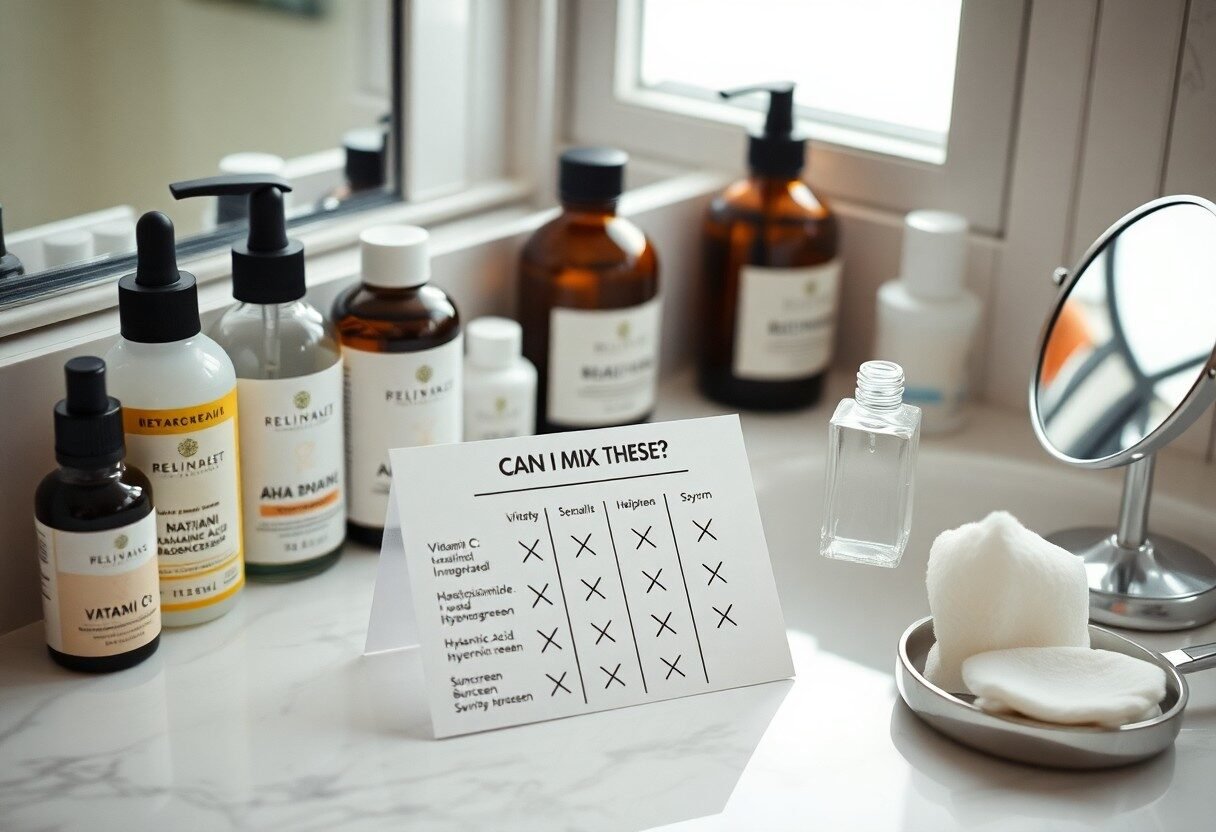
Many people ask which actives are safe to combine; I’ll give a practical, evidence-based guide so you can build routines that work. I explain dangerous mixes like retinol with benzoyl peroxide or layered acids, show helpful pairings such as niacinamide with hyaluronic acid, and outline timing and concentration rules so you avoid irritation. Use this cheat sheet to protect your skin, optimize results, and always follow with sunscreen.
Key Takeaways:
- Follow the thin-to-thick rule: water-based serums before oils and creams; finish with sunscreen in the morning.
- pH-sensitive actives (L‑ascorbic acid vs. AHAs/BHAs): avoid layering at once; separate by time of day or wait ~20-30 minutes between applications.
- Retinoids and strong acids increase irritation when combined; alternate nights or use a low concentration plus a moisturizer to buffer.
- Benzoyl peroxide can oxidize and destabilize vitamin C and may increase irritation with retinoids-use at different times or on different days.
- Niacinamide is broadly compatible with most actives, including vitamin C; if skin is reactive, introduce combinations slowly.
- Do not stack multiple exfoliants (chemical or physical) in one routine to avoid barrier compromise and sensitivity.
- When using photosensitizing actives (AHAs, retinoids), apply broad‑spectrum SPF daily and prioritize hydrating/barrier‑repair products to reduce irritation.
Understanding Active Ingredients
I separate actives by function and risk so you can layer with intent: exfoliants like AHAs (glycolic 5-10% OTC) and BHAs (salicylic 0.5-2%) thin the stratum corneum, retinoids (retinol 0.3-1%, tretinoin 0.025-0.1%) speed cell turnover and stimulate collagen, and antioxidants like L‑ascorbic acid (5-20%, pH <3.5) neutralize free radicals. I flag combos that raise irritation or inactivation risk, for example retinoids + AHAs/BHAs increase irritation and benzoyl peroxide can oxidize some actives.
Types of Actives
I categorize the common actives you’ll see into functional groups so you can match goals to safety: exfoliants, cell‑turnover agents, antioxidants, anti‑inflammatories, and barrier‑supporting molecules. I use typical concentrations and examples to judge potency and interaction potential-this helps decide morning versus night, buffer steps, or avoidance when you’re using prescription strength formulas.
- Retinoids (tretinoin, retinol)
- AHAs (glycolic, lactic)
- BHAs (salicylic acid)
- Vitamin C (L‑ascorbic acid)
- Niacinamide/Azelaic (barrier, anti‑inflammatory)
Knowing how each group affects pH, barrier function, and irritation risk lets me pair actives safely and prioritize what to avoid when you’re using potent prescriptions or combined DIY routines.
| Retinoids | Typical: 0.025-0.1% tretinoin or 0.3-1% retinol; high irritation risk when layered with AHAs/BHAs; use at night. |
| AHAs | Glycolic/lactic 5-10% OTC (peels up to 30%); acid exfoliation lowers pH and increases penetration of other actives. |
| BHAs | Salicylic acid 0.5-2%; oil‑soluble exfoliant good for comedonal acne but can increase dryness with retinoids. |
| Vitamin C | L‑ascorbic acid 5-20% at pH <3.5 for stability/efficacy; susceptible to oxidation and less active if mixed with strong oxidizers. |
| Niacinamide | Typically 2-5%; improves barrier, reduces redness, generally well‑tolerated with most actives. |
Mechanisms of Action
I focus on three mechanistic themes: exfoliation (AHAs/BHAs dissolve intercellular glue and lower surface pH), modulation of gene expression and turnover (retinoids bind nuclear receptors to upregulate collagen over months), and antioxidant scavenging (vitamin C neutralizes radicals and regenerates vitamin E). I cite numbers like visible texture gains in 4-8 weeks with AHAs and collagen signals rising after 3-6 months of retinoid use to set realistic timelines.
I also consider secondary effects: exfoliants acutely increase permeability by 20-50% depending on concentration, which can boost absorption of concurrent actives and risk irritation; retinoids cause transient epidermal thinning then long‑term thickening via collagen synthesis; and antioxidants can be inactivated by pH shifts or oxidizers, so I stagger application times when I prescribe multi‑active regimens to maintain efficacy and reduce adverse reactions.
The Importance of pH Levels
Skin sits around pH 4.5-5.5, and I treat pH as a mechanical rulebook: it governs whether an active is protonated, penetrates your skin, or simply sits on the surface. When you force incompatible pH combinations you risk reduced efficacy or increased irritation, so I prioritize sequencing and pH-aware pairing over blindly layering everything at once.
pH and Product Compatibility
I watch product labels and known ranges: l-ascorbic acid performs best below ~3.5, salicylic acid (pKa ~2.97) is effective under pH 4, while niacinamide prefers pH 5-7. If you combine a low-pH acid with niacinamide or a sensitive retinoid you can get possible flushing or irritation, so I either separate them by time (AM/PM or 20-30 minutes) or choose buffered formulations that match your routine.
How pH Influences Efficacy
pH relative to an ingredient’s pKa determines the proportion that’s protonated and skin‑penetrant; at pH = pKa you have ~50% protonated species. I use that principle: for acids like salicylic or glycolic, keeping formulas below their pKa increases penetration and activity, whereas many peptides and enzymes lose function at extreme pH, so balancing potency with tolerability is vital.
To put numbers into practice, I consider that shifting a formula from pH 4 to pH 3 can substantially increase the fraction of non‑ionized AHA available to exfoliate, and conversely, lowering pH around niacinamide risks slow hydrolysis toward nicotinic acid over time, which can produce unwanted flushing. In short, I tune timing, concentration, and vehicle to preserve both efficacy and barrier integrity.
Common Active Ingredient Pairings
I map common pairings to outcomes: vitamin C (10-20%) in the morning + SPF improves photoprotection; niacinamide (2-5%) with hyaluronic acid and ceramides soothes and hydrates; retinol (0.25-1%) at night paired with peptides/emollients supports collagen while reducing irritation; and salicylic acid (0.5-2%) with niacinamide targets oiliness and acne without heavy drying.
Compatible Combinations
Examples I use: L‑ascorbic acid (10-20%) AM + SPF; niacinamide 2-5% + hyaluronic acid for barrier support; retinol 0.25-1% PM + peptides/ceramides to repair overnight; azelaic acid 10-15% + niacinamide for redness/acne-prone skin; and salicylic acid 0.5-2% + niacinamide for clogged pores.
Red Flag Pairings
Cautions I flag: retinol + AHA/BHA often causes excessive irritation, retinol + benzoyl peroxide can reduce retinol potency, and pairing multiple strong exfoliants (two acids >10% at once) raises erosion risk; benzoyl peroxide + L‑ascorbic acid can oxidize vitamin C and lower efficacy.
To manage these risks I separate actives by timing: use vitamin C in AM and retinol at night, or alternate acid nights with retinoid nights. pH matters-L‑ascorbic acid works best pH ≤3.5-so formulations can conflict. I also advise patch testing, starting low (e.g., retinol 0.25%), and increasing frequency over 4-8 weeks rather than layering strong actives immediately.
Layering Techniques
I organize layers by function and texture: start with cleansers/toners, then watery hydrators like hyaluronic acid, followed by treatment serums, then thicker creams and oils. I follow the thin-to-thick rule and place pH-sensitive treatments where they won’t neutralize each other; for example, I put vitamin C (L‑AA, 10-20%) before moisturizers in the AM and always end with SPF when heading outside.
Application Order
I apply exfoliants (AHA 5-10% or BHA 1-2%) on clean skin first, let them sit, then layer targeted serums like niacinamide (2-5%) or peptide blends; antioxidant serums (vitamin C + E + ferulic) go next in the morning. Oils and occlusives come last. If I use retinoids, I reserve them for PM and place them after lightweight serums but before thick creams when tolerable.
Timing Between Layers
I usually wait 0-2 minutes for light serums to absorb, but for pH‑dependent actives I extend that: 15-30 minutes between a low‑pH AHA/BHA and L‑ascorbic acid or a retinoid to reduce neutralization and irritation. I avoid combining retinol and strong acids the same night because it significantly raises irritation risk.
For practical examples, I’ll do vitamin C (10-20%) in the AM, wait ~5-10 minutes if my skin feels tacky, then moisturizer and SPF. At night, if I use an AHA 10% I skip retinoid or separate by 24-48 hours; if I must pair them, I drop concentrations (retinoid to 0.025-0.05%) and wait ~20-30 minutes after the acid, plus patch test and start at 2×/week to build tolerance. Strong combinations like benzoyl peroxide with vitamin C I avoid because they can oxidize or inactivate one another.
Patch Testing for Sensitivity
Importance of Patch Testing
I treat patch testing as a quick risk filter before you commit to a new active: most reactions appear within 24-72 hours, and testing on a small area (2 cm square) behind the ear or on the inner forearm catches both immediate irritation and delayed contact dermatitis. I’ve seen clients avoid weeks of inflammation by catching a sensitivity in 48 hours, and you should stop use immediately if you see severe swelling, blistering, or spreading redness.
How to Conduct a Patch Test
I recommend this routine: cleanse a 2 cm area, apply a pea-sized amount of the product at the concentration you’ll use, mark the spot, and leave it uncovered or covered with hypoallergenic tape for 24-72 hours. I advise testing one product at a time, checking at 24 and 72 hours, and documenting any stinging, burning, or rash; discontinue immediately for intense symptoms and seek care for extreme reactions.
For more reliability I test leave-on actives for 48-72 hours but extend to 7 days for prescription retinoids, since cumulative irritation can appear later. I also avoid testing multiple actives simultaneously, test at the intended frequency (daily vs. every-other-night), and note that allergic reactions often show up after 48 hours while irritant responses are quicker-adjust plans based on that timing.
Special Considerations
I track patient history, procedures, pregnancy status and medication because these change layering rules: avoid topical and oral retinoids in pregnancy, do not combine recent oral isotretinoin with resurfacing procedures, and pause strong exfoliants around laser or microneedling. I also recommend a 48-72 hour patch test for new actives and spacing suspect combinations (e.g., vitamin C and benzoyl peroxide) into separate routines to limit irritation and preserve efficacy.
Skin Type Variations
I tailor frequency and strength by phenotype: oily/acne-prone skin tolerates salicylic acid 0.5-2% and benzoyl peroxide 2.5-5% more often, while dry/eczema-prone skin should avoid daily AHAs >10% and prioritize ceramides, humectants and occlusives. I advise sensitive or rosacea-prone skin to introduce one active at a time at low concentration and use niacinamide 2-5% as a generally well-tolerated anti-inflammatory option.
Seasonal Changes and Adjustments
I shift protocols with humidity and UV: in winter I cut exfoliation to 1-2× weekly, increase occlusives (petrolatum, ceramides) and consider lowering retinoid frequency; in summer I boost morning antioxidants (L-ascorbic acid 10-20%), enforce SPF 30-50 and avoid pairing daily AHA/BHA with retinoids because combined use raises irritation and photosensitivity.
For example, I’ll reduce a prescription tretinoin from 0.05% to 0.025% or move to every-other-night in low-humidity months, add a 5-10% urea or glycerin-rich cream for barrier repair, and switch to gel/serum textures in humid summer months. If you travel between climates, adjust immediately: persistent flaking or redness means back off exfoliants and prioritize a pH-neutral barrier cream until recovery.
Conclusion
With these considerations, I keep layering actives safe by prioritizing pH-compatible pairings, spacing incompatible ingredients across routines, and limiting frequency to avoid irritation; you should patch-test new combinations, introduce one active at a time, pause if your skin reacts, and consult a professional for persistent concerns.
FAQ
Q: Can I use vitamin C and retinol together?
A: You can, but separating them by time reduces irritation and optimizes each ingredient’s performance. Use a stable L-ascorbic acid serum in the morning (paired with sunscreen) and retinol at night. If you prefer to layer both in the same routine, apply vitamin C first, wait a few minutes for absorption, then apply retinol at lower concentrations and monitor tolerance. If irritation occurs, alternate nights or switch one product to a different time of day.
Q: Can I pair AHAs or BHAs with retinol?
A: Combining chemical exfoliants (AHAs/BHAs) and retinoids increases exfoliation and irritation risk. Options to reduce problems: use acids in the morning and retinol at night; alternate nights; use lower concentrations; or apply acids only once or twice weekly to build tolerance. Always follow with hydration and apply sunscreen daily, since both increase sun sensitivity.
Q: Is niacinamide safe to use with vitamin C, retinol, and acids?
A: Yes-niacinamide is broadly compatible. It pairs well with vitamin C (contrary to outdated concerns), retinol, AHAs/BHAs and azelaic acid. Niacinamide can reduce irritation and support barrier function, making it a good companion for stronger actives. If using multiple actives in one routine, apply niacinamide after water-based serums and before heavier moisturizers.
Q: Can benzoyl peroxide be used with vitamin C or retinol?
A: Benzoyl peroxide can oxidize L-ascorbic acid, reducing vitamin C’s effectiveness, so avoid layering them together; use vitamin C in the morning and benzoyl peroxide at night or alternate days. Benzoyl peroxide plus retinol increases dryness and irritation; if combined, lower concentrations and reduced frequency are advisable, with generous moisturizing and sunscreen.
Q: How do peptides, hyaluronic acid and ceramides fit into an active-heavy routine?
A: Peptides, hyaluronic acid and ceramides are supportive, low-risk layers that help hydration and repair. Apply hyaluronic acid on damp skin to attract moisture, peptides on top of hydrating serums, and ceramide-rich moisturizers last to seal the barrier. These ingredients can be used alongside most actives to mitigate irritation and improve tolerability.
Q: Can azelaic acid be layered with other actives like retinol, niacinamide and exfoliants?
A: Azelaic acid is versatile and generally well tolerated with niacinamide, retinol and most exfoliants; it can reduce redness and has antimicrobial effects. Combining azelaic acid with strong exfoliants or retinol may increase dryness for some people, so introduce combinations gradually and use supportive hydrating layers. If irritation appears, reduce frequency or use azelaic acid on alternate nights.
Q: What practical rules should I follow when building a routine with multiple actives?
A: Introduce one active at a time, waiting 2-4 weeks to assess tolerance before adding another. Prioritize sunscreen daily when using exfoliants or retinoids. Layer by texture and function: cleanse, water-based treatments (vitamin C, niacinamide), serums (retinoids at night), thicker treatments (peptides, azelaic acid), then moisturizers and oils. Start with lower concentrations, reduce frequency if irritation occurs, and patch-test new products. If severe irritation or persistent reactions happen, stop use and consult a dermatologist.
Continue exploring
Related posts:
 The Art of Layering Skincare Products for Maximum Benefits in Black Women
 The Art of Layering Skincare Products for Maximum Benefits in Black Women
 Layering Treatments and Moisturizers in Your Skincare Routine for Maximum Effect
 Layering Treatments and Moisturizers in Your Skincare Routine for Maximum Effect
 Combatting Dry Skin with Nourishing Skincare Products
 Targeting Fine Lines and Wrinkles with Skincare Products for Darker Skin Tones