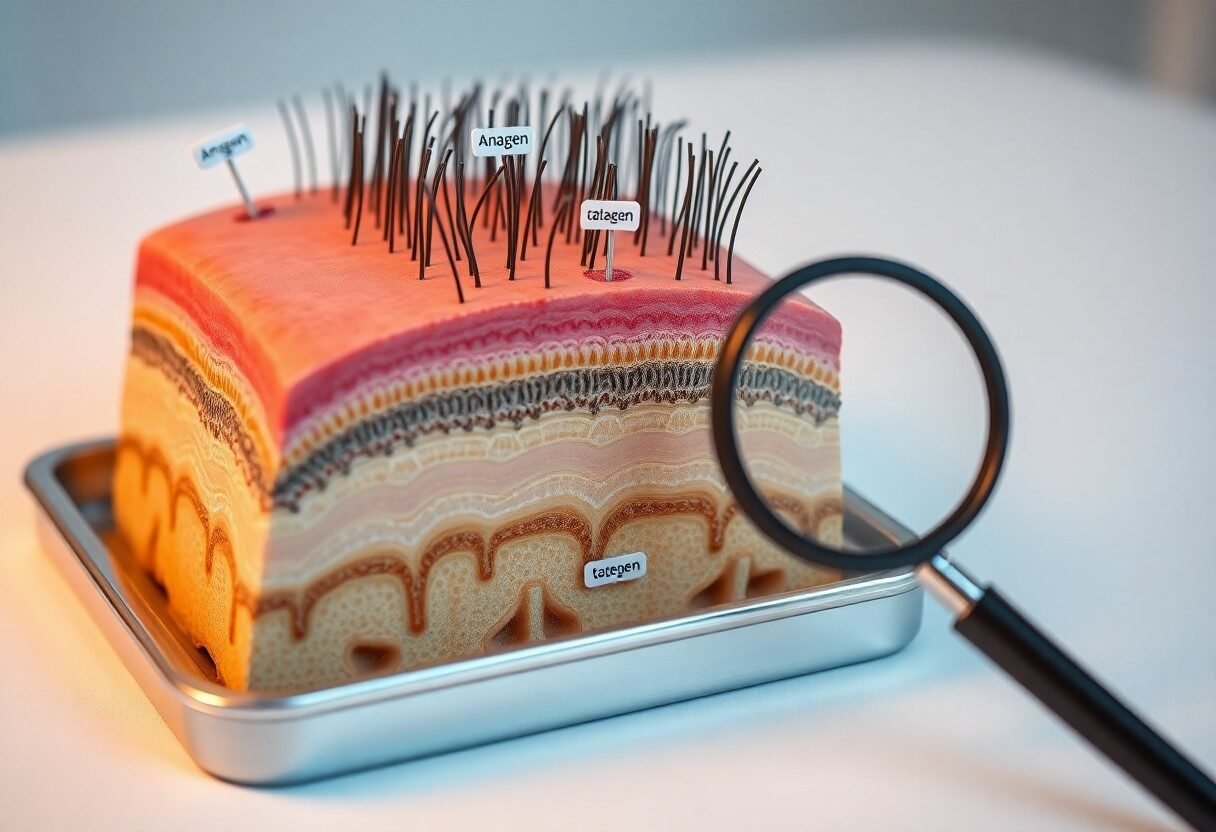
Many people misinterpret hair shedding, so I explain how your follicles cycle through anagen (growth), catagen (transition) and telogen (rest), and what each phase means for your hair density. I describe why sudden, persistent shedding can signal underlying health issues and when you should seek care, and how adequate nutrition, hormone balance and timely treatment can improve growth and reduce loss.
Key Takeaways:
- Hair grows in cycles: anagen (active growth, 2-7+ years), catagen (short transition), telogen (rest, ~3 months) and exogen (shedding).
- Average growth rate is about 0.3-0.4 mm/day (~1 cm/month), but genetics, age and hormones cause wide individual variation.
- Visual fullness depends on follicle count (set at birth) and shaft thickness; miniaturization reduces shaft diameter and causes thinning.
- Hormones and genetics drive many hair-loss patterns-dihydrotestosterone (DHT) often causes follicle miniaturization in androgenetic alopecia.
- Nutrition, stress, illness, medications and autoimmune conditions affect the cycle; deficiencies (protein, iron, vitamin D, zinc) and acute stress can trigger telogen effluvium.
- Normal daily shedding is roughly 50-100 hairs; sustained higher shedding indicates a shift in the growth cycle or underlying condition.
- Treatments (topical minoxidil, oral finasteride for men, PRP, low-level laser therapy, transplants) work best when follicles are still viable and the underlying cause is addressed.
The Anatomy of Hair
I examine hair from follicle to tip: the buried follicle drives the growth cycle, the shaft comprises the cuticle, cortex, and sometimes a medulla, and properties like diameter, pigment, and porosity dictate strength and styling; clinical observations link follicle inflammation to measurable drops in growth rate. Perceiving these structural roles lets you and I target interventions more effectively.
Structure of a Hair Strand
I break a strand into three layers: the outer cuticle of overlapping scales, the middle cortex of aligned keratin fibers that give strength and hold melanin, and sometimes the inner medulla which can be absent in fine hair; diameter varies roughly 17-180 µm across individuals and affects texture and breakage risk. Perceiving how each layer interacts helps you target treatments to strengthen and protect your hair.
- Cuticle: protective outer scales
- Cortex: keratin structure, color carrier
- Medulla: variable core, often absent in fine hair
- Diameter: 17-180 µm influences fragility
- Perceiving how layer damage alters porosity
Hair Types and Characteristics
I classify hair by shape and behavior-straight (round cross-section), wavy (oval), curly/coily (flattened), and by porosity and density; your sebum distribution on curls slows oil travel so curls often appear drier, and average growth is ~1 cm/month (~0.33 mm/day). Perceiving your hair’s type informs moisture, styling, and trimming routines.
- Straight: faster oil spread, shinier appearance
- Wavy: prone to frizz in humidity
- Curly: drier, needs more moisture
- Coily: higher shrinkage, fragile fibers
- Perceiving your type shapes routine choices
I note population trends: Asian hair often has a larger diameter and round cross-section giving straightness and higher tensile strength, African hair typically shows flattened cross-sections and tight coils that increase kink-related breakage, and Caucasian hair displays the widest variation; assessing tensile strength and porosity guides whether I recommend protein treatments or increased humectants. Perceiving these distinctions lets you choose targeted products and techniques.
| Cuticle | Overlapping scales that control shine and porosity |
| Cortex | Keratin bundles providing tensile strength and holding pigment |
| Medulla | Central core, present in coarse hair, absent in many fine strands |
| Follicle | Living structure in the dermis where growth cycles originate |
| Diameter | Ranges ~17-180 µm; dictates texture, strength, and styling response |
The Hair Growth Cycle
On the scalp, I see the cycle as a dynamic balance: about 85-90% of hairs remain in anagen (active growth), roughly 10-15% in telogen (resting), and ~1% in catagen (transition), with exogen representing shedding. I use these proportions to explain why losing 50-100 hairs daily is often normal, while abrupt increases or prolonged shedding suggest a shift in phase distribution that you should monitor closely.
Phases of Hair Growth
I break the cycle into four phases: anagen (active growth, typically 2-7+ years), catagen (brief involution, ~2 weeks), telogen (rest, ~3 months), and exogen (shedding). For example, an athlete under chronic stress may show an increased telogen proportion months after the event, and a patient with androgenic alopecia often presents with shortened anagen and miniaturized follicles.
Duration of Each Phase
I quantify durations to set expectations: anagen usually lasts 2-7+ years, catagen about 2-3 weeks, telogen ~3 months, and exogen can occur over days to weeks. Hair grows roughly 1 cm per month, so anagen length largely determines maximum terminal hair length and why some people can reach waist-length hair while others cannot.
I also note modifiers: genetics, age, hormones, nutritional status and medications change phase lengths-pregnancy often prolongs anagen, while severe illness or childbirth can trigger a telogen shift 2-3 months later. Chemotherapy causes anagen arrest and rapid loss, and if telogen effluvium persists beyond ~6 months it often indicates an underlying disorder that you and I should investigate further; treatments like minoxidil can extend anagen in many cases.
Factors Influencing Hair Growth
I categorize influences into inherited, hormonal, metabolic and environmental groups – genetics, hormones (notably DHT), nutrition, age, stress, medications, and styling or environmental damage; each can shorten anagen or push follicles into telogen, with telogen effluvium commonly occurring 2-3 months after a systemic trigger. This helps me prioritize what to test and treat.
- Genetics & Hormones
- Nutrition & Health
- Age & life stage
- Stress & illness (telogen triggers)
- Medications & medical conditions
- Mechanical & environmental damage
Genetics and Hormones
I evaluate family history because androgenetic alopecia affects roughly 50% of people by age 50; DHT, converted from testosterone, shortens anagen and promotes follicle miniaturization over years. I track pattern, onset age, and progression rate; for example, finasteride lowers scalp DHT by ~60% and often halts progression in men within 6-12 months, while women may need anti-androgen strategies tailored to hormones and contraception status.
Nutrition and Health
I screen diet and systemic factors since deficits drive shedding: iron deficiency and low ferritin (often <50 ng/mL in studies) link to hair loss, severe calorie or protein restriction precipitates telogen effluvium 2-3 months later, and untreated thyroid or vitamin D abnormalities commonly worsen shedding; correcting these frequently reduces shedding within 3-6 months.
I order targeted labs-CBC, ferritin, TSH, free T4, and 25‑OH vitamin D-and advise meeting at least the RDA (~0.8 g/kg) while often aiming for ~1.0 g/kg of protein for hair support (a 70 kg adult ≈ 56-70 g/day). I treat confirmed iron deficiency rather than empirical supplementation, and typically expect shedding to slow in 3-6 months with measurable regrowth by 6-12 months after correction.
Common Hair Growth Issues
Several frequent problems derail normal follicle rhythm: genetic thinning, systemic-triggered shedding, and inflammatory scalp disorders. I note that typical shedding is 50-100 hairs daily, but persistent excess or patchy loss signals pathology. For example, androgenetic alopecia affects about 50% of men by age 50 and up to 40% of women by menopause, while post-illness telogen effluvium often resolves in 3-6 months if the trigger is removed. I track density changes and texture to guide intervention timing.
Hair Thinning and Loss
Genetic, hormonal, and immune mechanisms produce distinct patterns: I separate patterned loss (androgenetic), diffuse shedding (telogen effluvium), and patchy autoimmune alopecia areata. Telogen effluvium can push you to lose hundreds of hairs daily for 3-6 months after stressors like surgery or severe illness. I frequently start topical minoxidil early; for men, finasteride reduces progression, and intralesional corticosteroids often help alopecia areata.
Scalp Conditions
Perturbations of the scalp-seborrheic dermatitis, psoriasis, tinea capitis, and folliculitis-directly impair follicle health. I observe dandruff (seborrheic dermatitis) in up to 50% of adults, while fungal or psoriatic plaques cause focal shedding and scaling. Using antifungal shampoos (ketoconazole, zinc pyrithione) or medicated topicals reduces inflammation, but unmanaged disease can progress to scarring alopecia, causing permanent hair loss.
Malassezia overgrowth commonly drives seborrheic dermatitis, so I recommend ketoconazole 2% shampoo twice weekly for months to control flares; scalp psoriasis responds to topical corticosteroids or calcipotriene, and tinea capitis requires systemic antifungals like terbinafine or griseofulvin, particularly in children. Bacterial folliculitis often implicates Staphylococcus aureus and may need topical or oral antibiotics. If you have persistent redness, focal thinning, or failed therapy after 6-8 weeks, I advise biopsy or specialist referral to exclude scarring processes.
Ways to Promote Healthy Hair Growth
Beyond cycle mechanics I prioritize targeted interventions: adequate scalp circulation, nutrient sufficiency, and reduced mechanical stress. I emphasize measurable targets-such as achieving 20-30 g of protein per meal, correcting iron or vitamin D deficiencies, and limiting chronic tension on follicles. I also monitor response over 3-6 months to see shifts from telogen to anagen, and escalate to topical or procedural therapies if labs and care changes don’t yield improvement.
Dietary Tips and Supplements
I focus on targeted nutrients and measurable labs:
- Protein: 20-30 g per meal to supply keratin building blocks.
- Biotin: supplemental 2,500-5,000 mcg daily when deficiency is suspected.
- Vitamin D: aim for serum 25(OH)D around 30-50 ng/mL.
- Iron: target ferritin >50 ng/mL in women with hair loss.
Perceiving and correcting these deficits often reduces shedding within 3-6 months.
Hair Care Practices
I minimize damage by using low-heat styling (keep tools at 150-180°C), detangling with a wide-tooth comb from ends upward, and opting for sulfate-free cleansers to protect the cuticle. I recommend avoiding daily tight styles to prevent traction alopecia, and tailoring wash frequency-often 2-3 times weekly-based on your scalp oiliness.
When more detail is needed I advise spacing chemical services every 6-12 months, using heat protectants and silk pillowcases to reduce friction, and performing a 60-120 second daily scalp massage to boost microcirculation. I escalate to evidence-backed options-like 5% minoxidil or clinic-based platelet-rich plasma-if conservative measures fail after several months.
Scientific Advances in Hair Growth Research
I track rapid progress in follicle neogenesis, where teams have produced hair-bearing skin organoids and prompted in vivo follicle formation; several Phase I/II trials now test stem-cell and exosome approaches. I note that genome-editing and cell-expansion methods can increase follicle yield, but off-target effects and tumorigenesis risks remain a major safety concern as therapies move from mice to humans.
Current Treatments and Technologies
I rely on proven tools: topical minoxidil and oral finasteride (both FDA-approved for androgenetic alopecia) typically show visible gains in 3-6 months, with fuller effects by 12 months. You can also use low-level laser devices (FDA-cleared) and PRP injections-efficacy varies across studies. For surgical options, FUE transplant techniques deliver ~90-95% graft survival when done by experienced teams, but side effects like scalp irritation or finasteride sexual effects require monitoring.
Future Directions in Hair Restoration
I expect the next wave to combine iPSC-derived follicles, CRISPR-driven gene correction, and biomaterial scaffolds to recreate native hair architecture. Early human pilot studies of cell-therapy and exosome implants suggest potential for durable regeneration, and regulators are evaluating safety endpoints closely. You should anticipate iterative approvals over the next 5-10 years as scalability and long-term safety data accumulate.
I follow company and academic programs exploring autologous dermal sheath/dermal papilla cell expansion (e.g., pilot programs by several biotech firms), exosome-based topical formulations, and 3D-printed follicle scaffolds; some studies report hair-count increases of 15-40% in small cohorts. I caution that manufacturing scalability, regulatory clearance, and high cost are real barriers, so wide clinical availability will depend on robust Phase II/III results and standardized outcome measures.
Final Words
From above, I summarize that understanding the hair growth cycle-anagen, catagen, telogen-helps you set realistic expectations, choose treatments that match your hair’s phase, and assess progress objectively; I encourage you to track patterns, consult professionals for persistent concerns, and prioritize consistent care to support healthier hair over time.
FAQ
Q: What are the phases of the hair growth cycle?
A: Hair progresses through four main phases: anagen (active growth), catagen (brief transition), telogen (resting), and exogen (shedding). Anagen determines how long a hair can grow, catagen signals follicle regression, telogen is a dormant state before a hair is shed, and exogen is the release of the old hair while a new anagen hair can start. At any time about 85-90% of scalp hairs are in anagen, 1-3% in catagen, and 10-15% in telogen.
Q: How long does each phase usually last?
A: Typical durations vary by individual and body site: anagen lasts about 2-7 years on the scalp (longer anagen yields longer potential hair length), catagen is 2-3 weeks, telogen is roughly 2-4 months, and exogen may overlap telogen for several weeks as shedding occurs. Ethnicity, genetics, age, and health influence these timings.
Q: What determines hair length and growth rate?
A: Maximum hair length is governed mainly by anagen duration; growth rate is influenced by genetics, hormones (especially androgens), age, and nutrition. Average scalp growth is about 0.3-0.4 mm per day (approximately 1 cm per month). Follicle size, local blood supply, and scalp health also affect how fast and how long hair grows.
Q: Can I speed up hair growth naturally?
A: Modest improvements are possible by optimizing factors that support the growth cycle: adequate protein and micronutrients (iron, zinc, vitamin D, B vitamins), managing stress and sleep, gentle scalp massage to improve circulation, avoiding chemical and mechanical damage, and treating scalp inflammation or infections. These measures help follicles operate at their genetic potential but usually do not dramatically exceed an individual’s baseline growth rate.
Q: Why does hair thinning or sudden shedding happen?
A: Thinning and shedding can result from several mechanisms: androgenetic alopecia (genetic DHT-driven miniaturization), telogen effluvium (sudden shift of hairs into telogen after stress, illness, or medication), alopecia areata (autoimmune attack on follicles), nutritional deficiencies, hormonal changes, and scalp disease. Telogen effluvium commonly presents as diffuse shedding 2-3 months after a triggering event.
Q: How do common medical treatments like minoxidil and finasteride work?
A: Minoxidil is a topical agent that can prolong anagen, increase follicle size, and enhance local blood flow, leading to thicker hairs for many users; visible effects typically take 3-6 months and require continuous use. Finasteride is an oral 5-alpha-reductase inhibitor that lowers DHT levels, slowing follicle miniaturization in androgenetic alopecia; improvements usually appear after several months and maintenance dosing is necessary to preserve gains. Both have variable responses and potential side effects to discuss with a clinician.
Q: How does scalp health influence the hair growth cycle?
A: A healthy scalp supports normal follicle function; chronic inflammation, excess sebum, dandruff, fungal or bacterial overgrowth, and physical damage create a hostile environment that can shorten anagen or promote shedding. Routine gentle cleansing, treating infections or dermatitis, protecting the scalp from harsh chemicals and heat, and addressing inflammation can help maintain optimal growth-cycle conditions.
Continue exploring
Related posts:
 The Science of Skincare – Understanding Ingredients for Black Women
 Understanding Humidity’s Effect on Natural Hair and How to Combat It
 Understanding Hair Porosity – What It Means and How to Test It
 Understanding the Different Curl Patterns and How to Care for Them
 The Impact of Stress on Hair Health and Growth
 The Truth About Hair Growth Oils and Supplements – What Actually Works?