At‑Home Hair Removal Devices for Dark Skin: Which Are Actually Safe?
Scrolling through social media or shopping online, it can feel like everyone has an at‑home hair removal device that promises smooth, hair‑free skin in just a few sessions. The allure is undeniable: the convenience of personal treatments, the promise of lasting results, and the potential for a significant reduction in the constant battle against unwanted hair. For many, these devices represent a modern solution to an age-old beauty concern, offering a glimpse into a future where daily shaving or frequent waxing might become a distant memory. Yet, for Black women with dark, melanin‑rich skin and often coarse hair, that promise comes with real, urgent questions that extend far beyond mere convenience.
The primary concerns are often rooted in safety and efficacy: Will this burn me? Will it leave stripes or dark patches? Is it even made for my skin tone? These aren’t hypothetical anxieties; they stem from a historical lack of inclusivity in beauty product development and a fundamental misunderstanding of how light-based technologies interact with melanin. At‑home laser and IPL (intense pulsed light) devices can be helpful for some, offering a bridge between traditional methods and professional treatments. However, it’s a critical truth that they were not all designed with deeper complexions in mind—and using the wrong one can mean burns, hyperpigmentation, or simply wasted money and emotional distress.
This comprehensive guide aims to demystify the world of at-home hair removal for Black women. We will break down how these at‑home devices work, meticulously explain what makes dark skin more vulnerable to adverse reactions, and empower you with the knowledge to discern what to look for on the box (and crucially, in the fine print). Our goal is to help you understand the nuances of these technologies, identify which features may offer a safer experience for melanin-rich skin, and ultimately, decide if trying one makes sense for your body, your budget, and your personal risk tolerance. This journey is about informed choice, self-protection, and honoring the unique beauty of your skin.
Understanding the Science: How At‑Home Hair Removal Devices Work
The vast majority of at‑home devices marketed for long‑term hair reduction operate on principles derived from professional laser and IPL technologies. They aim to achieve a similar outcome: disrupting the hair growth cycle to reduce hair density and thickness over time. This is accomplished by targeting the pigment within the hair follicle, converting light energy into heat, and thereby damaging the follicle’s ability to produce new hair. While the underlying concept is straightforward, the execution and safety for diverse skin tones require a deeper dive into the physics of light and melanin.
The Core Mechanism: Selective Photothermolysis
The scientific principle at play is called ‘selective photothermolysis.’ In simple terms, ‘photo’ refers to light, ‘thermo’ to heat, and ‘lysis’ to destruction. ‘Selective’ means that the light energy is designed to target a specific chromophore (a light-absorbing molecule) in the body, in this case, melanin within the hair shaft, while ideally sparing the surrounding skin tissue. When the light energy is absorbed by the melanin in the hair, it rapidly heats up the hair follicle to a temperature that damages its regenerative cells, leading to delayed hair growth or permanent reduction.
This selectivity is crucial. For the treatment to be effective and safe, there must be a significant difference in the amount of melanin in the hair compared to the amount of melanin in the surrounding skin. This contrast allows the light to preferentially target the hair without excessively heating the skin. This is precisely where the challenge arises for individuals with darker skin tones, as their skin naturally contains more melanin.
Laser Devices: Precision Targeting
Laser devices, whether professional or at-home versions, utilize a single, concentrated wavelength of light. This monochromatic, coherent light is highly focused and precise. Different types of lasers emit different wavelengths, and the choice of wavelength is paramount for safety and efficacy, especially on darker skin. For instance, Alexandrite lasers (755 nm) are typically used on lighter skin types, while Nd:YAG lasers (1064 nm) are often considered safer for darker skin tones because their longer wavelength penetrates deeper into the skin, bypassing the superficial melanin and targeting the hair follicle more effectively with less risk to the epidermis.
At-home laser devices are significantly less powerful than their professional counterparts. This lower power output is a safety feature, reducing the risk of severe burns, but it also means that results may be slower, less dramatic, and require more consistent use over a longer period. The precision of a single wavelength, however, still offers a degree of controlled targeting that can be beneficial.
IPL Devices: Broad-Spectrum Approach
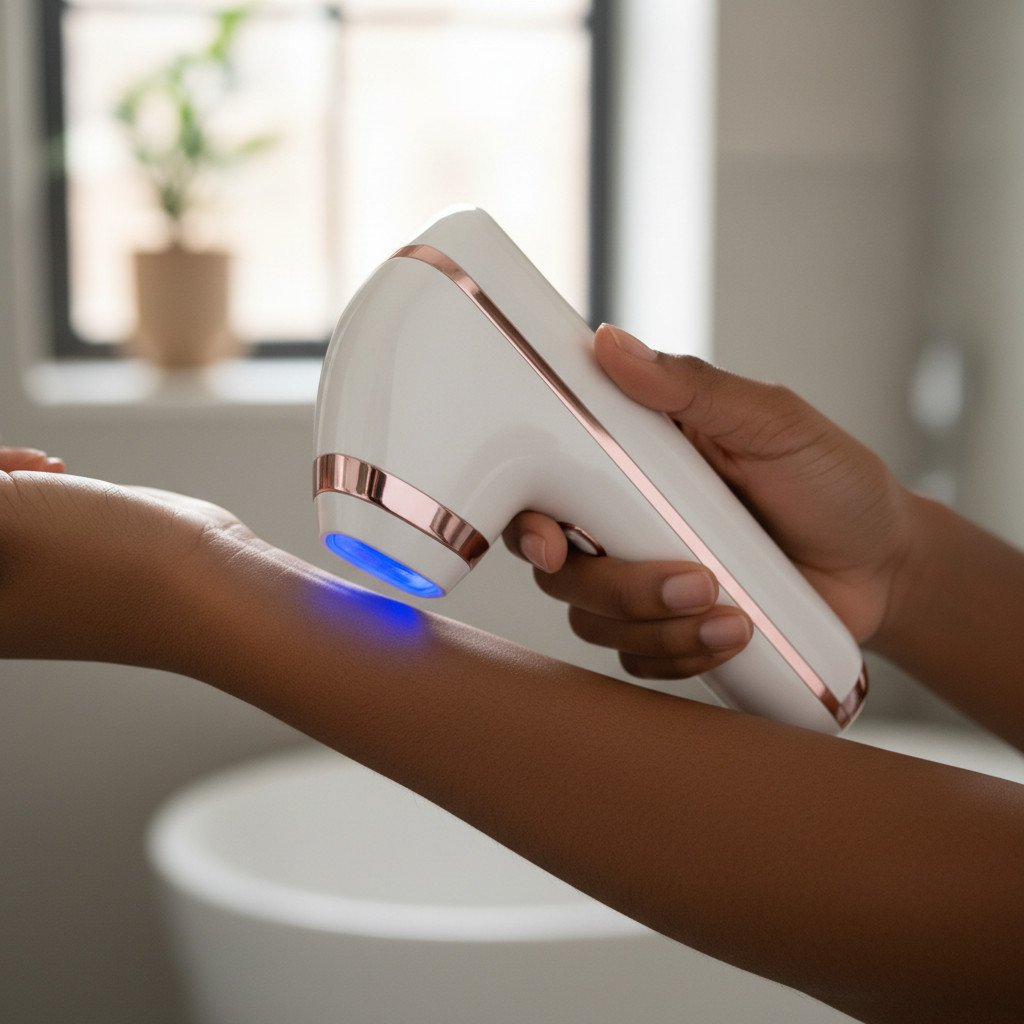
IPL (Intense Pulsed Light) devices, unlike lasers, use a broad spectrum of light wavelengths, typically ranging from 500 nm to 1200 nm. This broad-spectrum light is emitted in pulses and filtered to remove shorter wavelengths that could be harmful to the skin. The filters are designed to allow specific wavelengths to pass through, targeting various chromophores, including melanin in hair. Because IPL uses multiple wavelengths, it is generally considered less specific and more scattered than laser light.
While IPL can be effective for hair removal on lighter skin tones where there’s a strong contrast between hair and skin melanin, its broad-spectrum nature makes it inherently riskier for darker skin. The wider range of wavelengths means there’s a higher chance of the light being absorbed by the melanin in the epidermis, leading to unwanted heat absorption, burns, and hyperpigmentation. Many at-home IPL devices incorporate skin tone sensors and automatic intensity adjustments, but the fundamental challenge of broad-spectrum light on melanin-rich skin remains.
The Melanin Conundrum: Why Dark Skin is Different
On darker skin tones, where the skin itself contains more melanin, that crucial contrast between hair color and skin color is significantly smaller. This reduced contrast means that when a light-based device emits energy, a substantial portion of that energy can be absorbed by the melanin in the skin’s epidermis, rather than being selectively absorbed by the hair follicle. The result is that the skin heats up along with the hair, leading to potential thermal injury. This is the core reason why dark skin needs extra caution and why many devices are simply not suitable.
The ideal scenario for light-based hair removal is dark hair on light skin. This provides the maximum contrast, allowing the device to target the hair pigment efficiently without causing damage to the surrounding skin. As skin tone deepens, this contrast diminishes, and the risk profile shifts dramatically. Understanding this fundamental principle is the first step in making an informed decision about at-home hair removal.
Why Dark Skin Needs Extra Caution With Home Devices: A Deeper Dive
The promise of smooth, hair-free skin is alluring, but for Black women, the journey to achieving it with at-home light-based devices is paved with unique considerations and potential pitfalls. It’s not just about efficacy; it’s fundamentally about safety and preserving the health and beauty of melanin-rich skin. While at-home devices are indeed designed to be less powerful than professional machines, this reduction in power does not automatically translate to universal safety across all skin tones. In fact, for darker complexions, the nuances of device design and manufacturer recommendations become paramount.
The Melanin-Heat Absorption Cycle: A Critical Understanding
As we’ve established, melanin is a powerful light absorber. This natural pigment, responsible for the beautiful spectrum of skin tones, readily converts light energy into heat. In the context of at-home hair removal devices, this means that dark skin can soak up significantly more energy from these devices than lighter skin, especially if the wavelength or intensity isn’t precisely tuned with melanin-rich skin in mind. The problem isn’t the melanin itself, but the device’s inability to differentiate between melanin in the hair and melanin in the skin when the skin’s melanin content is high.
When too much heat is generated within the skin, the consequences can be severe and long-lasting. These include:

- Burns: The most immediate and painful risk. First-degree burns can cause redness and discomfort, while second-degree burns can lead to blistering and more significant tissue damage.
- Blisters: A sign of thermal injury, blisters indicate that the skin has been heated to a point where its layers separate. These can be painful and prone to infection.
- Hyperpigmentation (Dark Spots): This is one of the most common and distressing side effects for dark skin. When the skin is injured or inflamed (even subtly), it can respond by producing excess melanin, leading to dark patches that can take months or even years to fade. Post-inflammatory hyperpigmentation (PIH) is a significant concern, and for many Black women, avoiding PIH is a primary goal in any skin treatment.
- Hypopigmentation (Light Spots): In some cases, severe thermal damage can destroy the melanin-producing cells (melanocytes) in an area, leading to permanent lighter patches on the skin. This is often more difficult to treat than hyperpigmentation and can be cosmetically very challenging.
- Scarring: In extreme cases of burns or prolonged inflammation, scarring can occur, leading to textural changes in the skin.
These risks are not merely theoretical; they are well-documented outcomes when light-based hair removal is performed incorrectly or with unsuitable devices on darker skin. The pursuit of smooth skin should never come at the cost of skin health and evenness.
Device Limitations and the Unspoken Truth of Skin Tone Charts
A significant issue lies in how manufacturers design and test these devices. Historically, and often still today, many at-home hair removal devices are developed and tested primarily on lighter skin types (Fitzpatrick I-III) with dark hair. This demographic provides the ideal contrast for light-based hair removal, making it easier to achieve results with minimal risk. As a result, the efficacy and safety data for darker skin tones (Fitzpatrick IV-VI) are often limited or non-existent for many products.
This bias is explicitly reflected in the skin tone charts that accompany most at-home IPL and laser devices. These charts are not merely suggestions; they are critical safety guidelines. They depict which complexions the devices have been tested on, are approved for, and, crucially, which complexions they explicitly exclude. For many devices, the deepest skin tones are clearly marked as
Frequently Asked Questions
Are any at‑home IPL or laser devices truly safe for dark skin?
Some devices are explicitly tested and approved for use on deeper skin tones, but ‘approved’ doesn’t mean risk‑free—especially if instructions aren’t followed exactly. Checking skin tone charts, patch testing carefully, and starting with the lowest recommended settings are essential for any melanin‑rich skin.
Will an at‑home device fix my razor bumps permanently?
Reducing hair growth can decrease ingrowns over time, but at‑home devices are usually less powerful than professional lasers and may not eliminate bumps completely. Improving your grooming routine and aftercare still matters, even if you see some reduction in hair.
Is it better to try an at‑home device before going to a clinic?
“Better” depends on your priorities; home devices may feel more private and seem cheaper, but they shift all responsibility for safety and complication management onto you. If you’re very concerned about burns or pigment changes, a careful consultation at a reputable clinic may offer more guidance than guessing at home.
What if my skin tone is right at the edge of a device’s chart?
If you’re on the border of the listed safe range, you’re in a higher‑uncertainty zone for how your skin will react. In that case, extreme caution—slow patch testing, low settings, or even choosing not to use that device—may be the kinder choice for your skin.
Can I use at‑home devices on my face if I have dark skin?
The face, especially chin and jawline, can be more prone to pigment changes and scarring on dark skin, so treating it with at-home light devices carries added risk. If you consider it at all, patch testing in a very small area and seeking professional guidance first is wise.

What should I do if I get burned by an at‑home device?
Stop using the device immediately, gently cool the area (without ice directly on the skin), and use soothing, non‑irritating products while it heals. If you see blisters, severe pain, or color changes, contacting a medical professional as soon as possible can help minimize long‑term damage.
How long does it take to see results with at-home devices on dark skin?
Results vary widely based on the device, individual hair growth cycle, and skin type. For melanin-rich skin, starting with lower settings means a slower process. Expect to commit to several months of consistent treatments, often 12-18 sessions or more, before noticing significant hair reduction.
Are there any specific ingredients or products I should use after at-home hair removal?
After any hair removal, especially light-based methods, focus on gentle, hydrating, and soothing products. Look for ingredients like aloe vera, hyaluronic acid, and ceramides. Avoid harsh exfoliants, retinoids, or strong acids for several days to allow your skin to recover and prevent irritation.
Shop electric shavers for sensitive skin on Amazon
Shop IPL devices with skin tone sensor on Amazon
Shop gentle exfoliating body wash on Amazon
Continue exploring
Related posts:
 Home RF, Lasers, and Hair-Removal Devices for Dark Skin: Where to Draw the Line
 At‑Home Peels for Dark Skin: What’s Safe and What to Avoid
 The Ultimate Guide to Safe and Effective Earwax Removal with the Bebird M9
 Laser Hair Removal for Dark Skin: What to Ask Before You Book
 Tinted vs Clear SPF on Dark Skin: What Actually Shows Up
 How Eczema and Dermatitis Actually Look on Dark Skin