
There is a particular kind of skincare fatigue that arrives after you have tried to be diligent: the exfoliating toner, the brightening serum, the retinoid schedule, the spot treatment, the mask you bought because someone said it changed everything. Then one day, your face feels tight, hot, prickly, dry, shiny in an unfamiliar way, or simply impossible to read.
This is not a cue to panic, punish your skin, or decide that your complexion is “difficult.” It may be a cue to pause. A no-actives routine is a deliberately quiet stretch of skincare: cleansing gently when needed, moisturizing consistently, using sunscreen in daylight, and leaving the rest alone long enough to notice what your skin is communicating. It can be especially grounding when you are managing sensitivity alongside concerns such as uneven tone, post-inflammatory marks, dryness, or breakouts.
For Black women, femmes, and people with richly melanated skin, irritation can feel especially loaded because inflammation may leave visible tonal changes that take attention away from everything else. Still, richly melanated skin is not one uniform skin type, and race, ethnicity, pigmentation, and phototype do not tell the whole story of anyone’s barrier needs. This guide belongs within our broader skincare for Black women coverage because the most useful routine is not always the most ambitious one. Sometimes it is the one that gives your skin fewer things to argue with.
A no-actives routine is not giving up on your goals. It is a baseline. It helps you separate “I need more products” from “my skin needs less input.” Think of it as a calm, practical reset that makes later choices more informed. You are not behind because you need a simpler routine, and you do not have to earn gentleness by making your skin worse first.
What a no-actives baseline is—and what it is not
A no-actives baseline strips a routine back to supportive essentials. In most cases, that means a gentle cleanser, a plain moisturizer, and broad-spectrum sunscreen during the day. The purpose is not to create perfect skin. The purpose is to reduce avoidable variables while you pay attention to comfort, dryness, oiliness, congestion, and visible irritation.
“No actives” does not have one official universal definition. In this guide, it means pausing products you are using to intentionally exfoliate, speed cell turnover, fade discoloration, treat acne, or create a strong corrective effect. That commonly includes exfoliating acids, retinoids, benzoyl peroxide, strong vitamin C formulas, peeling pads, scrubs, and intensive masks. A product can be well formulated and still be too much for your face right now.
The baseline is about reducing friction
Skin can become reactive for many reasons: a new product, too many products introduced at once, weather shifts, shaving or hair-removal irritation, over-cleansing, rubbing with towels, fragrance exposure, or simply a routine that has become more elaborate than your skin enjoys. You do not need to identify one villain before simplifying. The point is to make the routine easier to tolerate and easier to evaluate.
Gentle cleansing and regular moisturizing are widely recommended basics for dry or sensitized skin. But “gentle” is more than a label or a low-pH claim. How much cleanser you use, how long it sits on your face, water temperature, rubbing, frequency, and what you apply afterward all shape the experience. A cleanser that is fine once daily may not feel fine twice daily during a sensitive stretch.
Melanin-rich skin deserves a low-drama approach
When skin is irritated, it may look red, deepened, grayish, purple-brown, ashy, patchy, or simply unlike your usual tone. On deeper complexions, subtle inflammation is not always obvious in the ways skincare marketing teaches us to look for it. Pay attention to sensation as much as appearance: stinging with water, persistent tightness, itching, tenderness, flaking, or a moisturizer that suddenly burns are all useful observations.
That does not mean every mark, texture change, or uneven area is irritation. Normal skin has pores, shadows, follicles, peach fuzz, old marks, and changing tone. You do not need to erase every variation to be caring for your face well. A baseline routine makes room for discernment instead of constant correction.
This approach is also useful if you are not sure whether you are “sensitive” in a lasting sense. You do not need a label to take a break from intensity. You only need enough information to recognize that your current routine is not feeling good, or that it has become too hard to understand what each product is doing.

What to pause, avoid, and stop trying to “push through”
The cleanest version of this reset is usually more helpful than a complicated compromise. If a product has a strong corrective job, set it aside temporarily rather than using it “just once” because you are worried about losing progress. Your skin is not a productivity project. Consistency with a short routine can be more useful than cycling between overdoing it and recovering from it.
Pause products with an active treatment role
Consider pausing exfoliating acids such as glycolic, lactic, mandelic, salicylic, and polyhydroxy acids; retinoids and retinol products; benzoyl peroxide; hydroquinone or other targeted fading treatments; strong or low-pH vitamin C serums; enzyme masks; peel pads; and acne spot treatments. This is not a declaration that these ingredients are bad. It is a temporary decision to remove intensity while you establish a calmer baseline.
Also pause physical exfoliation. That includes face scrubs, cleansing brushes, rough washcloths, gritty powders, and vigorous towel drying. “Natural” particles do not automatically make exfoliation gentle. If your face is tender, flaky, stinging, or easily flushed, friction can add more stress without giving you clearer information about what is causing the reaction.
Avoid hidden intensity and product pileups
Some routines become active-heavy without looking that way at first glance. A cleanser may contain salicylic acid, a toner may exfoliate, a moisturizer may include retinol, and a dark-spot serum may contain multiple brightening ingredients. Read the product’s purpose, directions, and ingredient list rather than relying only on the front label. If it says resurfacing, renewing, clarifying, peeling, correcting, pore-refining, or intensive, it deserves a closer look.
Fragrance can also complicate a sensitive period. Fragrance-free is not a guarantee that a product will suit you, but it can remove one common source of unnecessary exposure while you narrow down a routine. Our guide to choosing fragrance-free skincare for Black women can help you read labels without treating “clean,” botanical, or unscented marketing as proof of gentleness.
Do not substitute irritation with more treatment
It is understandable to see bumps, dullness, or uneven tone and reach for a stronger acid. But when the skin feels compromised, adding another corrective step can make it harder to tell whether you are dealing with congestion, irritation, dryness, or several overlapping concerns. The no-actives period is not the time to test a new peel, use a stronger percentage, or apply treatment products to “speed things up.”
Skip DIY acids, harsh astringents, lemon or citrus mixtures, undiluted essential oils, rubbing alcohol, and any product that asks you to ignore significant discomfort. Tingling is not a universal sign of effectiveness. Burning is not a beauty standard. Your face does not owe a product endurance.
It can help to move paused products out of your bathroom rather than leaving them where they invite an impulsive “maybe tonight.” Write down what you paused and why. This is not because you need to build a case against every product. It is because memory gets fuzzy when you are frustrated, and a brief note can help you avoid restarting three strong products at the same time.

Build the gentle routine: cleanse, moisturize, protect, observe
A baseline works best when it is boring enough to repeat. You are trying to create a routine with fewer moving parts, not a perfect lineup. Start with what you already own if it is plain, comfortable, and not clearly contributing to the problem. If you need replacements, introduce one category at a time rather than buying a complete new regimen in one shopping trip.
Morning: use the lightest useful version
In the morning, rinse with lukewarm water or cleanse gently if you wake up oily, sweaty, or prefer cleansing as part of your routine. Follow with moisturizer if your skin feels dry, tight, or more comfortable with it. Then apply a broad-spectrum sunscreen when you will be exposed to daylight. Sunscreen is not an active treatment in the sense used here; it is a protective step that can be especially useful when you are trying to avoid additional visible darkening of existing marks.
Choose a sunscreen you can apply generously and comfortably. On richer skin tones, that may mean finding a formula that does not leave an obvious cast, pill under makeup, sting around the eyes, or make you feel like avoiding the proper amount. A sunscreen you dislike using is not a moral failure; it is feedback about fit.
Evening: remove the day without stripping the face
At night, cleanse to remove sunscreen, makeup, sweat, and the day’s buildup. Use lukewarm rather than hot water, keep the massage brief, and pat dry instead of rubbing. If your cleanser leaves your face feeling squeaky, tight, or urgently thirsty, it may be too cleansing for this moment, or you may be using it more often than necessary.
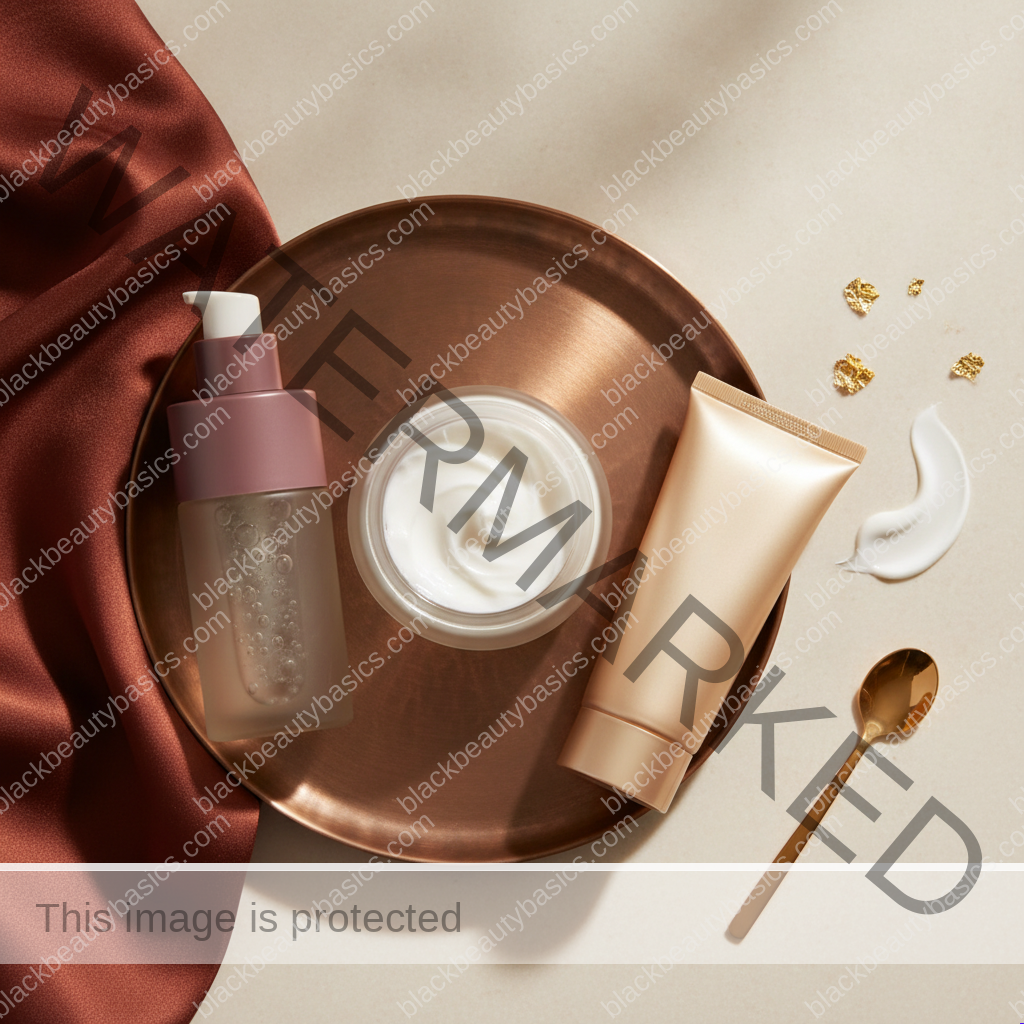
Apply moisturizer while your face is still slightly damp if that feels comfortable. You do not need to chase a complex ingredient list. Moisturizers can contain humectants that help hold water, emollients that soften, and occlusive ingredients that reduce water loss. There is no universal ideal formula or texture. A lightweight lotion may be enough for one person; another may prefer a cream, especially around the mouth, cheeks, or under the eyes.
How to choose your cleanser and moisturizer
For cleanser, look for a simple product designed for the face, preferably without added fragrance during a sensitive stretch. Consider your actual cleansing needs: someone who wears water-resistant sunscreen or makeup may need a more thorough but still gentle wash than someone who mostly rinses in the morning and cleanses once at night. If your skin feels dry, a non-foaming or low-foam texture may be worth trying, but the label alone cannot predict your personal response.
If you are replacing a cleanser, browse gentle fragrance-free face cleanser options by checking whether the product is intended for facial use, whether it avoids treatment acids, and whether the directions fit how often you plan to cleanse. A product is an optional tool, not a cure or a test of whether you are “doing skincare right.”
For moisturizer, seek a plain formula that feels comfortable across your face and does not rely on exfoliating or brightening claims. If you are prone to clogged pores, that does not automatically mean you need to skip moisturizer. It may mean choosing a lighter texture, using a smaller amount on oilier areas, or adjusting how you apply it. You can compare basic fragrance-free face moisturizers after looking for a straightforward formula without added treatment actives or a strong scent.
Keep a short, useful observation note
Do not turn the reset into a surveillance project. Once a day, notice a few simple things: Does water sting? Does moisturizer sting? Are you tight by midday? Are dry areas calmer, unchanged, or spreading? Are new bumps appearing in the same places? Is sunscreen comfortable? A brief note helps you spot patterns without magnifying every pore in the mirror.
If you make a change, make one change. Switching cleanser, moisturizer, sunscreen, and laundry detergent at once may feel decisive, but it gives you very little information. A slower approach is not less intelligent; it is more legible. It also leaves room for normal day-to-day changes in your skin without assigning every shift to the newest bottle.
Adjust the baseline for the skin situation you actually have
A no-actives routine can stay simple while still being flexible. You do not have to apply every product identically to every inch of your face. Skin can be oily through the center, dry around the mouth, reactive near the eyes, and comfortable on the cheeks all at once. That variation is ordinary, not evidence that your skin is failing the routine.
If your face feels dry, tight, or flaky
Try cleansing once daily at night and using a water rinse in the morning if that works for you. Apply moisturizer to slightly damp skin and use a little more on areas that consistently feel tight. You can layer a second thin application on dry patches rather than coating your entire face in a heavy amount that feels uncomfortable elsewhere. Our practical guide to layering moisturizer on dry patches and oily zones offers a more targeted way to work with mixed needs.
Keep showers and face washing comfortably warm instead of hot. If hard water seems to leave your skin feeling rough or tight, be gentle with your conclusions: water quality may be one factor for some people, but it is not always the explanation, and changing water systems is not a guaranteed solution. Focus first on the steps you can observe directly, such as cleanser amount, washing time, and moisturizer use.
If you are oily or suddenly congested
Do not respond by stripping your face or skipping moisturizer altogether. Use a modest amount of a lightweight moisturizer, especially where skin feels tight after cleansing. Make sure your sunscreen, makeup, hair products, and pillowcase habits are not adding avoidable variables, but resist the urge to overhaul everything at once. Congestion can have many causes, and a sensitive period is not the best time to aggressively chase every bump.
If a richer moisturizer seems to sit heavily on your oiliest areas, apply less there and more where needed. You can also choose a lotion rather than a dense balm-like texture. The goal is comfort and consistency, not forcing one finish across your whole face. It is also okay if a temporary baseline does not deliver the matte, glassy, or highly polished look that an active routine was designed to pursue.
If makeup, shaving, or hair products are part of the picture
During a reset, simplify what touches the edges of your face. Heavy fragrance, strong setting sprays, makeup-removal wipes, and hair products that transfer onto the forehead or temples can make it harder to read your skin. That does not mean you must stop wearing makeup or styling your hair. It means choosing gentler removal, cleaning brushes and tools, and noticing whether irritation clusters where certain products make contact.
If shaving or hair removal leaves you tender, avoid applying corrective actives immediately afterward. Use a gentle cleanser and moisturizer instead, and pay attention to whether friction, blade freshness, technique, or product sting is part of the pattern. A small adjustment in contact and aftercare can be more useful than adding another serum to compensate.

Troubleshoot calmly and know when a professional should be involved
A baseline routine should feel easier over time, not like a daily endurance exercise. If every product still burns, simplify further. Pause anything nonessential, rinse with lukewarm water, use only the most comfortable basic moisturizer you have tolerated, and stop testing new products. Our article on what to do when every skincare product burns offers a focused next step for that specific experience.
When the problem may be the routine, not your skin
Common routine issues include cleansing too often, applying too many layers, returning to an active too quickly, using a treatment cleanser plus treatment serum, rubbing dry patches, or trying to correct a reaction with a mask. It is also possible for a product you used for months to become less comfortable when your routine, weather, or skin condition changes. You are allowed to retire a product that no longer fits.
If you suspect you overdid exfoliation, do not restart acids because your skin begins to look dull or textured. That can be a hard moment emotionally, especially when you are concerned about old marks. Read our guidance on how to reintroduce exfoliation after overdoing acids only once your baseline feels reliably comfortable and you are ready to make a measured decision.
When to seek medical care
Seek prompt medical advice for swelling of the face, lips, eyes, or throat; hives; blistering; severe pain; oozing or crusting; rapidly spreading rash; signs of infection; eye involvement; or trouble breathing. Stop using a product that appears to trigger a significant reaction. A dermatologist or other qualified clinician can assess concerns that persist, worsen, leave you unsure, or interfere with daily life.
Professional care can also be useful if you are managing recurring rashes, painful acne, persistent itching, changes that concern you, or marks that are affecting your well-being. A clinician can help distinguish between conditions that look similar online and offer options suited to your history. You do not have to self-diagnose from a product review or wait until discomfort becomes extreme.
Bring a short product list, photos of the labels, and notes about timing if you seek care. Include prescription products, over-the-counter treatments, hair products that touch your face, and anything recently added or used more often. Clear information can make an appointment more productive, but do not delay care because you cannot create a perfect timeline.

What to Do Next
For the next stretch of your routine, choose your smallest sustainable version: cleanse gently when needed, moisturize, wear sunscreen in daylight, and pause the urge to add a solution for every visible change. Put treatment products somewhere out of immediate reach so the decision is intentional rather than automatic.
Once your skin feels consistently comfortable, you can decide whether you want to reintroduce anything at all. If you do, add one product with one purpose rather than rebuilding an entire active routine overnight. For a bigger picture of matching routines to different needs, visit our routine design guide for different skincare goals. The goal is not to prove that you can tolerate the most. It is to build a routine your skin and your real life can live with.
Frequently Asked Questions
How long should I follow a no-actives skincare routine?
There is no single calendar rule because sensitivity, product history, weather, and underlying skin concerns vary. Stay with the basic routine until it feels consistently comfortable rather than judging it after one calm morning. Look for practical signs such as less stinging, less tightness after washing, and fewer moments when moisturizer feels uncomfortable. If symptoms are persistent, worsening, or difficult to interpret, a dermatologist can offer individualized guidance. The goal is not to rush back to actives on a deadline; it is to make your next decision from a steadier place.
Can I use sunscreen during a no-actives reset?
Yes. Broad-spectrum sunscreen is generally part of a no-actives baseline because its role is protection, not exfoliation or corrective treatment. Choose one that feels comfortable enough to wear in an adequate amount when you will be exposed to daylight. If your current sunscreen stings, pills, leaves a cast you cannot comfortably wear, or seems to aggravate your skin, simplify the rest of your routine first and consider trying a different formula later. Sunscreen preferences are personal, especially across deeper skin tones and different daily schedules.
Does niacinamide count as an active ingredient?
It depends on how the product is formulated and how your skin responds. Niacinamide is common in moisturizers and serums, and some people tolerate it well. But during a strict reset, it is reasonable to pause a separate niacinamide serum, especially if it is new, highly concentrated, or combined with several other brightening ingredients. A plain moisturizer that happens to include niacinamide may be fine for some people, but you do not need to keep it in rotation if you are trying to remove variables. Comfort is the priority.
Can I still wear makeup while I am pausing actives?
Yes, if makeup feels comfortable and you can remove it gently. A no-actives routine is not a requirement to stop presenting yourself in ways that make you feel like yourself. Keep the surrounding routine simple: avoid harsh wipes, scrubby removal, and repeated cleansing to chase every trace of makeup. Clean brushes and sponges regularly, and notice whether irritation gathers where a primer, setting spray, edge product, or makeup tool touches your face. If makeup burns or worsens a reaction, pause it until you can identify a gentler option.
What if I get breakouts after stopping my acne treatments?
That can feel discouraging, particularly if you paused treatment because your skin was already irritated. Do not interpret every new blemish as proof that the reset has failed. Breakouts and irritation can overlap, and adding several acne products back at once can create more confusion. Keep cleansing and moisturizing gentle, avoid picking, and consider professional guidance if acne is painful, widespread, scarring, or affecting your quality of life. When you do reintroduce treatment, one product and one schedule at a time gives you clearer information than a full routine restart.
Should I stop cleansing in the morning if my skin is sensitive?
Some people with dry or reactive skin prefer a lukewarm water rinse in the morning and a gentle cleanse at night. Others feel better cleansing lightly twice daily, especially if they are oily, sweat overnight, or use heavier nighttime products. There is no virtue in forcing either approach. Pay attention to how your skin feels after cleansing and by midday. If morning cleansing leaves you tight, squeaky, or uncomfortable, reducing that step may be worth trying. If skipping it feels unpleasant, use a small amount of a mild cleanser.
When can I reintroduce an exfoliant or retinoid?
Consider reintroduction only after your basic routine is stable and your skin is not regularly stinging, peeling, or feeling tender. Choose one active product, begin conservatively according to its directions, and avoid pairing it with other exfoliating steps at first. It is wise to keep your cleanser, moisturizer, and sunscreen unchanged during that trial so you can better understand what your skin is tolerating. If discomfort returns, pause rather than trying to force an adjustment period. More treatment is not automatically better treatment.
Related next steps
Related posts:
 How to Layer Actives Safely on Melanin-Rich Skin
 How to Layer Actives on Dark Skin (Vitamin C, Niacinamide, Retinoids, Acids)
 How to Add Actives Without Overwhelming PIH-Prone Skin
 “Can I Mix These Products?” A Cheat Sheet for Layering Actives
 Night Skincare Routine for Melanin-Rich Skin When You Are Too Tired for a Full Routine
 Barrier Repair Routine for Sensitive Dark Skin: Your Gentle Guide