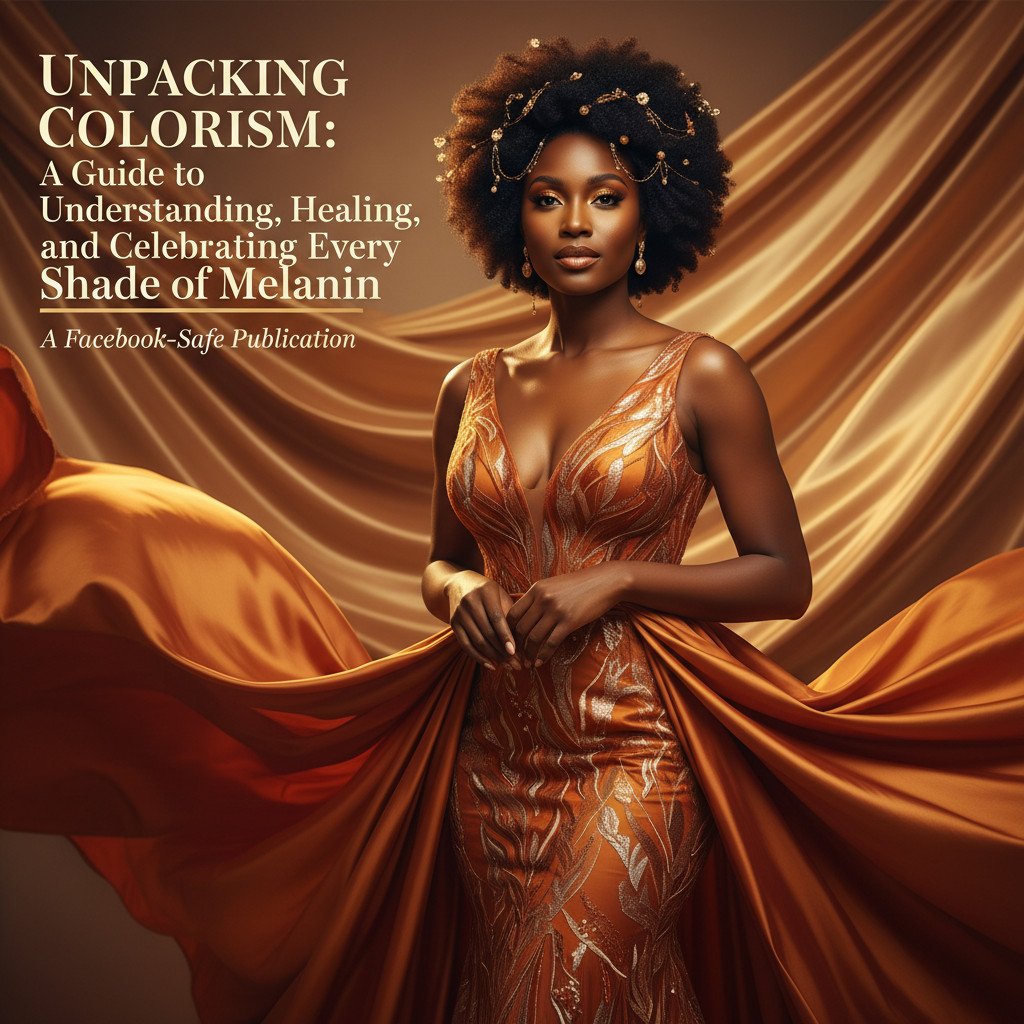
The first time someone told me I was pretty ‘for a dark-skinned girl,’ I didn’t have the words to explain why it hurt. It took years to understand that the compliment was never really a compliment at all—it was colorism wearing a mask. If you’ve ever felt the sting of comparison, the pressure to lighten, or the subtle suggestion that your beauty is somehow conditional based on the hue of your skin, you know this pain.
For generations, the Black community has wrestled with an insidious internal division: colorism. It is a painful legacy that impacts our self-worth, our relationships, and our perception of what constitutes true Black beauty. But we are here today, on the pages of Black Beauty Basics, to unpack this history, confront its present reality, and chart a course toward collective healing and radical self-acceptance. Our melanin is a masterpiece, and every shade deserves to be celebrated, affirmed, and loved without reservation.
1. Defining Colorism and Its Origins: The Root of the Divide
Colorism is often confused with racism, but while they are related, they are distinct. Racism is prejudice directed against someone based on their race. Colorism is prejudice or discrimination against individuals with a darker skin tone, typically among people of the same racial group.
The Historical Blueprint: Slavery and Colonialism
The roots of colorism in the African diaspora are deeply embedded in the systems of chattel slavery and colonialism. Slave owners often assigned lighter-skinned enslaved people (often the result of sexual assault by white masters) to domestic roles inside the ‘big house,’ granting them marginally better treatment, education, and opportunities than those with darker skin, who were relegated to the grueling field labor.
This created a hierarchy where proximity to whiteness—represented by lighter skin—was associated with privilege, intelligence, and desirability. This false, damaging narrative was internalized and passed down through generations, creating a preference for lighter skin and ‘good hair’ that persists today.
Understanding the Terminology: Colorism vs. Featurism
While colorism focuses on skin tone, it often works in tandem with featurism—the prejudice against certain facial features (like broad noses or full lips) that are stereotypically associated with Blackness. Both are tools of white supremacy designed to divide and conquer, making it crucial that our journey toward melanin pride addresses both.
2. How Colorism Shows Up Today: Real-World Impacts
Colorism is not just about personal preference; it has tangible, measurable effects on the lives of Black women across various sectors.
In Media and Entertainment
Observe the casting choices in major films and TV shows. Historically, and often still today, the Black female lead—the love interest, the successful professional, the ‘unproblematic’ character—is disproportionately lighter-skinned. This sends a powerful, destructive message that lighter skin is the default standard for beauty and success.
In the Workplace and Education
Studies have shown that darker-skinned Black individuals often receive harsher sentencing in the judicial system and face greater difficulty securing employment or higher wages, even when controlling for education level. This economic disparity is a direct consequence of systemic colorism.
In Intraracial Dating and Family Dynamics
Perhaps the most painful manifestation of colorism occurs within our own homes and communities. The preference for lighter partners, the ‘paper bag test,’ and the subtle—or not so subtle—comments from family members about a child’s complexion or hair texture are deeply wounding and erode self-acceptance from a young age.
“The colorism that exists within our community is a wound we must collectively decide to heal. It tells us that some of us are more worthy than others, and that is a lie we must stop repeating.”
3. The Beauty Industry’s Role: Perpetuating the Standard
The beauty industry, while increasingly diverse, has historically been a major engine of colorism, capitalizing on the insecurity it creates.
The Skin Lightening Epidemic
Globally, the market for skin-lightening products is massive, driven by the belief that lighter skin is superior. These products, often containing dangerous ingredients like mercury or high doses of steroids, pose severe health risks to women seeking to conform to Eurocentric standards. We must reject the notion that we need to alter our natural hue to be beautiful.
The Shade Range Problem
While many brands have improved, the ‘Fenty Effect’ highlighted how long Black women—especially those with deep, rich complexions—were ignored. When foundations stop at ‘tan’ or when the deepest shades are poorly formulated (ashy or red), it is a clear message of exclusion. Always support brands that authentically cater to the full spectrum of Black skin tones, from the lightest caramel to the deepest ebony.
Actionable Steps for Consumers:
- Demand Inclusivity: Only purchase foundation and concealer from brands that offer 40+ shades, ensuring true representation at the deep end of the spectrum. (e.g., Fenty Beauty Pro Filt’r Soft Matte Longwear Foundation)
- Reject Lightening: Avoid products marketed explicitly for ‘whitening’ or ‘bleaching.’ Focus instead on products that promote even tone and hyperpigmentation correction, like those containing Niacinamide or Vitamin C. (e.g., The Ordinary Niacinamide 10% + Zinc 1%)
- Celebrate Deep Tones: Share images and reviews of products that look stunning on deep skin tones, particularly blushes, bronzers, and lipsticks that truly pop.
4. Internal Work: Examining Our Own Biases
Healing from colorism starts with radical honesty about our own internalized beliefs. We are all products of a colorist society, and acknowledging our own biases is the first step toward dismantling them.
The Self-Reflection Checklist
Ask yourself these uncomfortable but necessary questions:
- When I see a darker-skinned woman and a lighter-skinned woman achieve success, do I subconsciously assign different narratives to their journeys?
- Do I use phrases like ‘pretty for a dark-skinned girl’ or ‘she has good hair’ (meaning looser curl patterns)?
- Do I unconsciously prioritize lighter-skinned individuals in my social media feed or dating preferences?
- How do I react internally when a dark-skinned woman is celebrated as the epitome of beauty in media? Is there resistance or immediate affirmation?
Practicing Radical Affirmation
To counteract decades of negative programming, we must actively affirm the beauty of deep melanin. This means seeking out and celebrating dark-skinned women in all their glory—not just when they fit a specific mold, but in their everyday existence.
Affirmation Exercise: Look in the mirror and repeat: “My skin is a gift. My shade is magnificent. I am worthy of love and celebration, exactly as I am.”
5. Raising Colorism-Aware Children
We have the power to break the cycle. Raising children who are truly colorism-aware requires intentionality and consistent messaging.
Curating a Melanin-Rich Environment
Ensure your child’s world reflects the full spectrum of Blackness. This includes:
- Books and Toys: Purchase dolls, books, and media featuring Black children of all skin tones, especially those with deep complexions and natural hair textures. (e.g., books by Vashti Harrison or dolls from Healthy Roots Dolls)
- Positive Role Models: Point out and celebrate successful, beautiful, and powerful dark-skinned women in history and contemporary culture (e.g., Viola Davis, Lupita Nyong’o, Toni Morrison).
- Language Matters: Never use skin tone descriptors as terms of endearment or criticism. Avoid phrases like ‘light-skinned and spoiled’ or ‘dark and lovely’—just use ‘lovely.’
Addressing Colorist Comments
When a child or family member makes a colorist comment, address it gently but firmly. Explain that all shades of melanin are beautiful because they are unique expressions of our heritage. Teach children that beauty is not conditional on lightness.
6. Celebrating All Shades of Melanin: The Power of Unity
Our strength lies in our unity. When we stop allowing colorism to divide us, we unlock a powerful collective confidence.
The Beauty of Melanin
Melanin is not just a pigment; it is a shield, a complex biological marvel, and the source of our signature glow. It protects us from sun damage and gives us that enviable, youthful appearance well into our later years. Every shade—from the softest honey to the deepest espresso—tells a story of resilience, heritage, and unparalleled beauty.
| Shade Spectrum | Common Beauty Challenge | Affirmation |
|---|---|---|
| Deep/Dark Tones | Lack of representation, hyperpigmentation visibility | My depth is regal. My skin is rich and luminous. |
| Medium/Brown Tones | Feeling ‘in-between,’ struggles with undertone matching | My warmth is grounding. I am the perfect balance of heritage and grace. |
| Light/Fair Tones | Accusations of not being ‘Black enough,’ sun sensitivity | My lightness is inherited, not earned. I am 100% Black and beautiful. |
7. Resources for Continued Learning and Healing
The journey toward healing is ongoing. Educate yourself, engage in dialogue, and support those who are doing the work.
Recommended Reading and Viewing:
- Book: The Color Complex: The Politics of Skin Color Among African Americans by Kathy Russell, Midge Wilson, and Ronald Hall.
- Documentary: Dark Girls (2011) and Light Girls (2015) by Bill Duke.
- Academic Work: Explore the writings of Dr. Sarah L. Webb, founder of Colorism Healing.
Practical Tips for Daily Healing and Self-Acceptance:
- Curate Your Feed: Unfollow accounts that promote unrealistic or colorist beauty standards. Follow accounts that celebrate diverse Black beauty.
- Practice Gratitude for Melanin: Every morning, thank your skin for its strength and beauty.
- Speak Up: When you witness colorism—whether in a family gathering or online—address it calmly and educate the person on its harmful impact.
- Invest in Your Skin: Treat your skin with the respect it deserves. Use high-quality, melanin-friendly products. (e.g., CeraVe Hydrating Facial Cleanser)
The Melanin Mandate: Our Commitment to Wholeness
Colorism is a heavy cloak woven from historical trauma, but it is not our destiny. We have the power to shed it, piece by piece, through awareness, empathy, and fierce, uncompromising self-acceptance. Your shade is perfect. It is sacred. It is the legacy of queens and kings, and it holds the light of the sun and the mystery of the earth.
Let us commit today to celebrating every single hue in our beautiful Black rainbow. Let us affirm that beauty is not a spectrum where ‘light’ is better than ‘dark,’ but a boundless universe where every star shines equally bright. Go forth, radiant woman, and let your unique melanin glow illuminate the world.
Now, tell us: What steps are you taking today to heal from internalized colorism and celebrate your unique shade? Share your journey in the comments below.
Related posts:
 Beyond the Shade: Why Sunscreen is a Non-Negotiable for Black Women
 The Melanin Guide: Mastering Skincare for African American Women (That Protect Your Glow)
 The Melanin Guide to Barrier Repair: How to Heal and Strengthen Your Skin’s Protective Shield
 The Melanin Morning: Building a Self-Love Ritual That Sticks and Elevates Your Day
 Cut Crease Mastery for Hooded Lids: Make Your Eyeshadow Pop on Melanin-Rich Skin
 The Elegant Edit: Building a Capsule Wardrobe That Celebrates Your Melanin and Style