When dark spots are sitting on your face, it is easy to believe stronger must mean better. Stronger acids, stronger scrubs, stronger peels, stronger promises. But on Black skin and other melanin-rich complexions, irritation can become part of the dark-spot cycle. If your routine keeps your skin stinging, peeling, tight, or raw, it may be slowing the progress you are trying so hard to make.

This guide is about how to fade dark spots without wrecking your barrier. We will talk about why the barrier matters, what to stop doing, how to build a gentler plan, and what to do when your skin is already irritated. For the broader foundation, BBB’s facial hyperpigmentation guide explains how acne marks, melasma, uneven tone, and inflammation fit together on deep skin.
Why the Barrier Matters for Dark Spots
Your skin barrier is the outer protective system that helps hold water in and keep irritants out. When it is calm, your skin usually feels more comfortable, products are easier to tolerate, and the routine is easier to repeat. When it is disrupted, your skin may feel tight, burning, itchy, rough, flaky, shiny in a stressed way, or suddenly sensitive to products that used to be fine.
For melanin-rich skin, barrier stress matters because inflammation can trigger more visible pigment. A routine that is technically full of “brightening” ingredients can still backfire if it keeps irritating the skin. That does not mean dark-spot ingredients are bad. It means they need to live inside a routine that respects the barrier. The skin cannot fade comfortably while it is constantly defending itself.
Dark spots often begin with inflammation: acne, eczema, bug bites, waxing irritation, shaving bumps, picking, burns, or harsh products. If your routine adds more inflammation, the skin can keep producing pigment even while you are trying to treat pigment. This is why BBB talks so much about gentleness. Gentleness is not weakness. It is strategy.
The barrier also affects consistency. If a product leaves you raw, you may stop using it, restart it, layer something else over it, then stop again. That cycle makes it hard to see what is working. A slower routine that your skin accepts is often more useful than an intense routine you can only tolerate for four days.
What to Stop Doing When You Want Spots to Fade
Stop using pain as proof. Burning, sharp stinging, and aggressive peeling are not reliable signs that a product is working. Sometimes they are signs that the skin is irritated. On deep skin, that irritation can lead to more hyperpigmentation. A gentle tingle from certain products can happen, but discomfort that makes you brace yourself is not something to normalize.
Stop stacking actives just because each one is popular. Vitamin C, retinoids, azelaic acid, exfoliating acids, tranexamic acid, benzoyl peroxide, and acne treatments can all have a place in skincare, but not all at once for every person. If your routine has multiple strong steps and your skin is dry, tender, or shiny-tight, the problem may be crowding. Your face does not need every good ingredient at the same time.
Stop over-exfoliating. Exfoliation can make skin feel smooth, which makes it tempting to repeat too often. But dark spots are not simply sitting on top of the skin waiting to be scrubbed away. Pigment can sit at different depths. Scrubbing or using acids too frequently can irritate the barrier without meaningfully speeding the fade. For many people, less frequent exfoliation or none at all for a while is the safer move.
Stop changing everything at once. If you introduce a new cleanser, serum, toner, exfoliant, moisturizer, and sunscreen in the same week, you will not know which product helped or hurt. This is especially risky when your skin is already reactive. Introduce one meaningful change at a time. Your routine should generate useful information, not more confusion.
Stop skipping sunscreen while using treatments. Many dark-spot routines make the most sense when sunscreen is consistent. UV exposure can deepen the look of hyperpigmentation and make fading feel slower. If sunscreen has been hard because of cast or texture, treat that as a product-fit problem. It is worth finding a formula that respects deep skin.
Build the Gentle Plan: Calm, Treat, Protect
The first step is to calm the baseline. Use a gentle cleanser that does not leave your skin tight. If your cleanser makes you feel squeaky clean, it may be removing more than you need. A cleanser should leave your skin ready for care, not begging for relief. If you need examples to compare, look for a product type like gentle fragrance-free face cleanser, then choose based on your skin’s tolerance rather than hype.
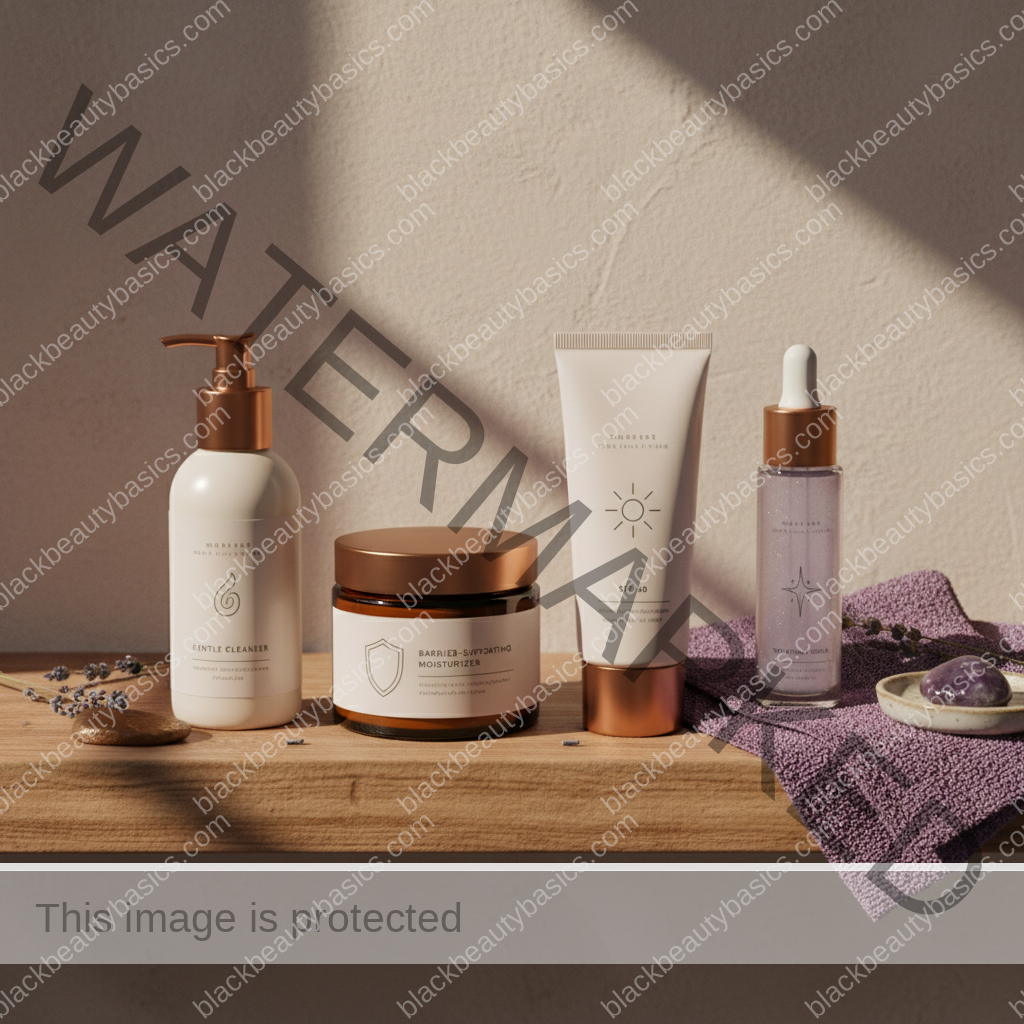
The second step is to moisturize with intention. A barrier-supporting moisturizer helps reduce dryness, tightness, and irritation. Look for a texture you will use daily: gel-cream for oilier skin, lotion for balanced skin, richer cream for dry skin, or different textures for different seasons. Helpful moisturizer criteria include comfort, non-stinging application, and ingredients that support hydration and barrier feel. If you need a search starting point, compare options like fragrance-free barrier repair moisturizer.
The third step is to choose one treatment lane. If acne is still causing new marks, acne control may be the priority. If the marks are old and breakouts are calmer, a pigment-focused ingredient may make sense. Options often discussed for uneven tone include azelaic acid, niacinamide, tranexamic acid, vitamin C, retinoids, and gentle exfoliating acids. You do not need all of them. One well-tolerated treatment is better than five that keep your skin inflamed.
The fourth step is sunscreen in the morning. Sunscreen helps protect the progress you are trying to make, especially on areas exposed to daylight. Choose broad-spectrum SPF 30 or higher when possible. Deep skin deserves formulas that do not leave a chalky cast. If you are comparing product types, a search like broad-spectrum sunscreen for dark skin with no white cast can help you understand what exists, but wearability is the real test.
A simple morning might be rinse or gentle cleanse, moisturizer if needed, and sunscreen. If you tolerate a morning treatment, place it before moisturizer or sunscreen depending on formula directions. A simple evening might be cleanse, one treatment on selected nights, and moisturizer. Recovery nights with no active treatment can be part of the plan. They are especially useful if your skin is sensitive, newly irritated, or adjusting.
How to Use Actives Without Starting a Fight
Introduce one active at a time. Use it a few nights a week or according to directions, then watch your skin. Signs that your skin is tolerating it include mild dryness that improves with moisturizer, no persistent burning, no sudden roughness, and no new irritation pattern. Signs to slow down include stinging, peeling, itching, tightness, increased breakouts from irritation, or marks looking darker after repeated discomfort.
Do not combine strong actives just because they are all recommended for dark spots. A retinoid night does not need to be an acid night. A vitamin C morning does not need three other brightening serums underneath. The skin can only process so much before the routine becomes noise. If you are using prescription acne or pigment treatments, follow your clinician’s instructions first.
Consider buffering if you are sensitive. Some people apply moisturizer before a retinoid to reduce irritation, or use moisturizer after treatment to cushion dryness. This may be especially helpful on areas that get easily irritated, like around the mouth or nose. Buffering is not cheating. It is a way to keep the treatment in your life without letting it dominate your barrier.

Keep exfoliation modest. If your skin is not irritated and you choose an exfoliating acid, start slowly. Once or twice a week may be plenty for many people. Do not use exfoliation to compensate for impatience. If your marks are deep or tied to ongoing inflammation, more exfoliation may not solve the real issue. BBB’s guide to routine order for fading acne marks can help you place treatments without crowding the routine.
Troubleshooting: When Your Barrier Is Already Upset
If your barrier is already upset, pause the fading push. Return to a boring routine: gentle cleanser, moisturizer, sunscreen. Avoid scrubs, peels, strong acids, retinoids, fragranced extras, and new experiments until your skin feels comfortable again. This pause can feel frustrating when dark spots are visible, but it may prevent a longer setback.
If your skin burns when you apply moisturizer, simplify even more and consider professional guidance. Burning with basic products can mean the barrier is very irritated or that a product does not suit you. If there is swelling, oozing, intense itching, severe pain, or a rash that is spreading, do not try to brightening-serum your way through it. Get medical help.
If your marks are not improving but your skin is calm, look at time and trigger control. Are new pimples still appearing? Are you picking? Are you skipping sunscreen? Are you using a treatment often enough to matter? Are you expecting a month-old routine to erase a year-old pattern? BBB’s guide to how long hyperpigmentation takes to fade can help reset expectations.
If your discoloration is patchy, symmetrical, or recurring, compare it with BBB’s PIH vs melasma guide. Melasma-like pigmentation may need different support and stronger light-protection habits. More exfoliation is not the answer to every patch.
Frequently Asked Questions
1. Can I fade dark spots with only gentle products?
Some mild marks may improve with trigger control, moisturizer, sunscreen, and time, especially if irritation stops. Many people eventually add a treatment ingredient, but gentle basics still matter. Without them, stronger products may be harder to tolerate. Think of gentle care as the foundation, not the consolation prize.
2. How do I know if my barrier is damaged?
Common signs include stinging, burning, tightness, flaking, sudden sensitivity, rough texture, redness or warmth, and products that used to feel fine becoming uncomfortable. On deep skin, irritation may not always look bright red, so pay attention to sensation and texture. If symptoms are severe, persistent, or rash-like, seek professional care.
3. Should I stop all actives if my skin is irritated?
Often, yes, at least temporarily. Pause exfoliating acids, retinoids, strong brightening serums, and harsh spot treatments while the skin calms. Keep the routine simple with cleanser, moisturizer, and sunscreen. Reintroduce one active at a time only after comfort returns.
4. Is peeling necessary for dark spots to fade?
No. Peeling is not proof that pigment is fading. Sometimes peeling means the product is too irritating or too frequent. Dark spots can improve without visible peeling when the routine reduces inflammation, protects from UV exposure, and uses tolerated treatments consistently.
5. Can I use retinoids if I have dark spots?
Retinoids can be helpful for some people, especially when acne and texture are part of the picture, but they must be introduced carefully. Start slowly, moisturize well, and use sunscreen. If you are pregnant, trying to conceive, breastfeeding, or using prescriptions, ask a clinician what is appropriate.
6. What if sunscreen breaks me out?
Look for a different texture or formula rather than skipping sunscreen entirely. Some people do better with lightweight fluids, gels, or formulas labeled non-comedogenic. Also make sure you cleanse thoroughly at night. If every sunscreen seems to break you out, a dermatologist can help you sort irritation from acne triggers.
7. When should I see a dermatologist?
See a dermatologist if dark spots are spreading, changing, linked to painful acne or rashes, or not improving after consistent gentle care. Also seek help if products repeatedly irritate you or if you suspect melasma. Professional support can protect both your skin and your patience.

What to Do Next
Fading dark spots without damaging your barrier starts with a mindset shift: the goal is not to force pigment out of the skin. The goal is to reduce triggers, protect from new darkening, support comfort, and use treatments carefully enough that your skin can stay in the routine. That is slower than the internet wants it to be. It is also kinder and often smarter.
Pick one next step. If your skin is irritated, simplify for two weeks. If your sunscreen is inconsistent, solve that texture problem. If acne keeps creating marks, focus on prevention. If you are using multiple actives, choose one lane and give your barrier room to breathe.
For more structure, read why dark spots last longer on deep skin, then organize your steps with routine order for fading acne marks. If your pattern looks patchy or keeps returning, compare it with PIH vs melasma on dark skin. Your skin deserves patience, but it also deserves a plan that does not confuse pain with progress.
Related next steps
Related posts:
 Best Ingredients to Fade Dark Spots on Dark Skin (Vitamin C, Azelaic, Kojic, etc.)
 How Long Hyperpigmentation Takes to Fade on Melanin-Rich Skin
 How Long Does Hyperpigmentation Take to Fade on Dark Skin? Expectations and Timelines
 How to Treat Acne on Dark Skin Without Causing Dark Spots
 Why Dark Spots Last Longer on Deep Skin
 Facial Dark Spots After Waxing or Threading on Deep Skin