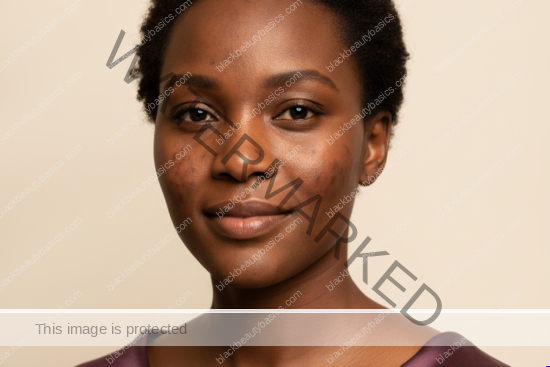
Tweezing facial hair can be practical, familiar, and deeply personal. It can also leave behind a frustrating mark: a darker dot, patch, or shadow where the hair, follicle, or skin was irritated. If that happens to you, it is not proof that you are doing something wrong, that your skin is “too sensitive,” or that you should be ashamed of having facial hair in the first place.
Many Black women remove chin, jawline, upper-lip, and cheek hair for comfort, preference, grooming, or confidence. Facial hair is normal. So is choosing to leave it alone. The problem is not the hair. The concern is the inflammation that can happen when a hair is pulled, breaks below the surface, becomes ingrown, or is picked at afterward. In melanin-rich skin, inflammation can sometimes leave post-inflammatory hyperpigmentation, often called PIH. That means the skin produces or retains extra pigment after irritation or injury.
Dark marks after tweezing deserve care, not blame. They are not a sign that you need to scrub harder, use a stronger acid, or chase a lighter complexion. The goal is healthy, comfortable skin and fewer new marks—not changing the color or character of your skin. Black skin is not biologically identical from person to person, either. Your sensitivity, hair texture, skin conditions, medications, hormone history, and past reactions all matter.
It can be especially discouraging when the hair takes seconds to remove but the mark stays visible long after the tenderness has gone. That frustration is real. Still, your face is not a project that needs constant correction. A slower, less reactive approach can help you protect your skin while making grooming decisions that fit your life, budget, and comfort.
This guide focuses on reducing avoidable irritation, supporting the skin barrier, and knowing when recurring hair growth or marks deserve professional support. For broader context on discoloration, visit our Hyperpigmentation & Dark Spots guide. You do not need to punish your face to care for it.
Why Tweezing Can Leave Dark Spots on Melanin-Rich Skin
Tweezing removes a hair from the follicle by pulling it out at the root. That action can cause temporary inflammation even when it seems minor. A little redness, tenderness, or a raised bump may settle quickly, but the pigment response can stay visible longer. When a spot follows a pimple, ingrown hair, scratch, burn, rash, or grooming irritation, it may be PIH.
PIH is not a separate “stain” sitting on top of the skin. It is a pigment response after inflammation. In deeper skin tones, that response may look brown, gray-brown, deep purple-brown, or darker than the surrounding skin. The exact color and persistence can vary. A mark that began after tweezing may be from the pulled follicle itself, but it may also be related to a trapped hair, follicle inflammation, acne, or repeated touching.
Facial hair texture matters. Curly or tightly coiled hairs are more likely to curve back toward the skin after removal. When a hair grows into or re-enters the skin, it can trigger an ingrown hair and inflammation. This is often discussed in relation to shaving, but the underlying issue—hair and follicle irritation—can also matter when tweezing. A tender bump, a visible trapped hair, or repeated bumps in the same area may need a more cautious approach than simply plucking again.
Technique can also make a difference. Tweezing against the direction of hair growth, pulling the skin roughly, repeatedly gripping a hair that will not release, or using tools that are not clean can increase irritation. So can tweezing skin that is already dry, flaky, sun-exposed, actively breaking out, or irritated by strong skincare products.
It is worth separating a dark spot from a dark “shadow.” If there is still a hair beneath the surface, a coarse hair growing back, or dense growth in a small area, you may be seeing more than pigment alone. Repeatedly digging for the hair can make both the follicle and the mark worse. A gentler removal plan is usually more useful than trying to achieve a perfectly hair-free result in one session.
PIH can be emotionally draining because the original bump may disappear before the mark does. That does not mean the mark is permanent, and it does not mean you failed at skincare. It means the skin is still settling after irritation. Our guide to the post-inflammatory hyperpigmentation timeline in deep skin explains why fading is often gradual and why preventing new inflammation matters as much as treating older marks.

What to Avoid When You Are Trying to Prevent New Marks
The fastest way to make a tweezing-related mark harder to manage is to keep creating new irritation in the same area. That can happen with a cycle of pluck, bump, pick, scrub, and pluck again. Breaking that cycle is not about being perfect. It is about reducing the number of small injuries your skin has to recover from.
Avoid digging for hairs that are trapped under the skin. It is tempting to use pointed tweezers, pins, or fingernails to free a hair. But breaking the skin can create a larger inflammatory response than the original hair. If a hair is not easily accessible, leave it alone for the moment. Trying to “finish the job” can turn a tiny bump into a longer-lasting mark.
Avoid picking, squeezing, or scratching post-tweeze bumps. A bump may be an irritated follicle, an ingrown hair, acne, or another skin concern. It cannot be reliably identified by appearance alone at home. Picking adds friction and may introduce more irritation. If you notice yourself touching the same spot while checking the mirror, consider stepping away from close-up inspection for a few days.
Avoid harsh exfoliation right after hair removal. Grainy scrubs, rough washcloths, cleansing brushes, peel pads, and several active ingredients layered together can leave the skin stingy and inflamed. “Feeling it work” is not a useful standard for facial skincare. Stinging, burning, persistent redness, or new flaking are signs to simplify, not intensify.
Avoid waxing, threading, depilatories, or shaving over visibly irritated skin just to remove every hair. Each method has potential benefits and drawbacks, but changing methods in the middle of an active flare can make it hard to tell what your skin tolerates. Give angry skin a chance to calm before experimenting.
Avoid using someone else’s tweezers or using visibly dirty tools. Clean tools are basic harm reduction. Wash your hands, clean the tweezer tips according to the manufacturer’s directions, and let them dry before use. Do not share tools that may contact skin or follicle openings.
Avoid treating pigment with random “brightening” mixtures. Lemon juice, baking soda, undiluted essential oils, toothpaste, and harsh bleaching products can burn or irritate skin. A burn can lead to more discoloration, especially on melanin-rich skin. Skin lightening pressure is often rooted in colorism; you do not have to risk your skin to meet a narrow standard of evenness.
Be particularly cautious with at-home peels, aggressive exfoliation, and procedures marketed as quick fixes. Reviews of PIH treatment note that procedures can carry a risk of worsening pigmentation, especially when skin is irritated or treatment is not appropriately selected. If you are considering a peel, laser, microneedling, or another procedure for facial marks, discuss it with a dermatologist or clinician experienced in treating darker skin tones. Do not try to recreate a professional procedure at home.
A Gentle, Practical Plan for Tweezing Facial Hair
A good plan should reduce unnecessary trauma without making grooming feel like a medical project. Start by deciding what your skin can realistically tolerate. If tweezing has repeatedly left bumps or marks, it may not be the best primary method for that area. You are allowed to choose a lower-maintenance approach, remove fewer hairs, or pause hair removal while your skin settles.
Before tweezing: Work on clean, dry skin with clean hands and a clean tweezer. Use good lighting, but try not to turn grooming into a long magnifying-mirror session. If the area feels raw, has open skin, has a crusted lesion, or is actively burning from skincare, skip tweezing that day. If you use prescription acne, pigment, or retinoid treatment, follow your prescriber’s instructions about hair removal and product use. Do not stop or alter a prescription on your own because of this article.
During tweezing: Focus on individual, clearly visible hairs. Hold the skin gently taut if needed, grasp the hair close to the skin without pinching the skin itself, and pull in the direction the hair is growing. Use a steady pull rather than repeated tugging. If a hair breaks or resists, do not keep chasing it. Move on. Less complete hair removal can be kinder to the skin than a “perfect” result achieved through repeated pulling.
After tweezing: Keep the routine calm. Rinse if needed, then use a gentle, fragrance-free moisturizer that does not sting. Avoid rubbing the area with a towel. If you normally wear sunscreen, apply one that you can use comfortably and consistently. Broad-spectrum sunscreen helps protect skin from ultraviolet exposure, which can make discoloration more noticeable. The American Academy of Dermatology recommends choosing broad-spectrum sunscreen with SPF 30 or higher and using it as directed.
For many people, the simplest routine is enough after hair removal: gentle cleanser, bland moisturizer, and sunscreen during the day. If your skin is currently irritated, this is not the time to test a new exfoliating toner, scrub, or multi-acid serum. Let comfort guide you. Skin that feels calm is generally easier to manage than skin that is constantly being challenged.
Try to avoid treating the post-tweeze period as a deadline for “fixing” a spot. The immediate priority is not fading pigment overnight. It is avoiding a fresh round of inflammation. If you want to use over-the-counter care for existing marks, wait until the area is intact and comfortable, then make changes slowly enough to understand what your skin is tolerating.
If you want to use over-the-counter ingredients for existing dark marks, introduce only one at a time and avoid applying it to broken or freshly irritated skin. Ingredients such as azelaic acid or niacinamide may be included in routines for uneven tone, but no ingredient is a guaranteed cure, and tolerance differs widely. A careful guide to layering niacinamide, azelaic acid, and sunscreen for dark spots can help you think through routine order without turning your face into an experiment.
Patch testing can reduce surprises when you are trying a new product, although it cannot predict every reaction. Apply a small amount to a discreet area as directed and watch for irritation. If a product causes burning, swelling, a rash, or persistent discomfort, stop using it and seek medical advice if symptoms are severe or do not settle.
Real-Life Variations: Chin Hair, Hormonal Changes, Acne, and Sensitive Skin
There is no single “Black women’s facial hair” story. Some people tweeze a few occasional chin hairs. Some manage dense growth along the jaw or upper lip. Some notice more facial hair around hormonal shifts, after medication changes, or alongside acne. Others have sensitive skin, eczema, or a history of marks after nearly every form of hair removal. Your plan should reflect your actual pattern, not a generic routine.
If you get one or two occasional hairs: Tweezing may be manageable when done gently and infrequently. Keep your tool clean, avoid plucking on irritated skin, and resist checking the area repeatedly afterward. A few visible hairs do not require an aggressive removal routine.
If you get clusters of coarse hairs on the chin or jaw: Take note of the pattern. Repeated tweezing in the same small zone can lead to repeated inflammation. Consider whether trimming, carefully shaving, or professional options might be less disruptive for your skin. There is no universally best method. The right choice is the one that causes the least irritation for you and fits your life.
If bumps appear after nearly every removal session: Your skin may be reacting to the technique, the method, active skincare products, or hairs becoming ingrown. A short pause from tweezing can be useful while you simplify your routine. If bumps are painful, recurrent, pus-filled, spreading, or leaving scars, seek evaluation from a dermatologist or qualified clinician. You deserve care that takes your skin tone and hair texture seriously.
If acne and facial hair overlap: It can be hard to know whether a bump is acne, follicle irritation, or an ingrown hair. Avoid treating every bump as an ingrown hair. Picking at acne and digging at follicles can both increase the risk of marks. A clinician can help when the pattern is persistent or when you are unsure what you are seeing.
If you have eczema, psoriasis, hidradenitis suppurativa, or frequent skin injury: Hair removal may need a more individualized plan. Inflammatory skin conditions and injuries can be followed by PIH, and active irritation deserves priority over cosmetic hair removal. Read more about condition-linked PIH from eczema, psoriasis, HS, and injuries for a fuller discussion of protecting vulnerable skin.
If you notice a dark or velvety patch on the neck: Do not assume it is simply from hair removal, friction, or “dirt.” Dark neck patches can have different causes and should be assessed by a clinician, especially if the change is new, thickened, spreading, or accompanied by other symptoms. Our resource on dark neck changes, friction, hormones, and when to seek help offers practical next steps without diagnosing from appearance.
Troubleshooting Marks That Keep Returning
When dark spots keep appearing after tweezing, focus less on fading each individual mark and more on identifying what keeps restarting the cycle. This is not about blaming yourself. It is a practical way to protect your skin from repeated inflammation.
Problem: The same follicle becomes dark and bumpy.
Possible next step: Stop trying to pull from that spot until the skin is calm. Do not squeeze or excavate it. Consider whether the hair is growing inward or whether repeated tweezing is causing too much irritation. If the bump recurs often, becomes painful, or scars, get professional guidance.
Problem: Your face stings after tweezing and skincare.
Possible next step: Reduce the number of products used immediately after hair removal. A gentle cleanser and fragrance-free moisturizer may be enough for the moment. Hold off on scrubs, acids, retinoids, and strong spot treatments unless a clinician who knows your routine has advised otherwise. Persistent burning is not a normal goal of treatment.
Problem: You are removing hair more often because the area looks darker.
Possible next step: Pause and look closely at whether you are responding to pigment, regrowth shadow, or both. More frequent plucking can create more inflammation and more visible marks. A less frequent schedule or a different method may be kinder to your skin.
Problem: Dark marks are spreading beyond where you tweeze.
Possible next step: Consider other sources of irritation, including acne products, fragranced cosmetics, rubbing from masks, skin conditions, or sun exposure. If the change is widespread, new, rapidly changing, itchy, painful, or otherwise concerning, arrange a clinical assessment rather than continuing to add products.
Problem: You bought several pigment products and now your skin feels worse.
Possible next step: Simplify. More active ingredients do not automatically mean better results. Stop using products that clearly irritate your skin, return to a basic routine, and reintroduce only one carefully chosen product at a time if appropriate. A dermatologist can help you decide whether prescription options are suitable; use any prescribed treatment exactly as directed and speak with the prescriber before making changes.
Problem: You are considering a facial peel or laser because you are tired of the marks.
Possible next step: Book a consultation with a clinician experienced with deeper skin tones and PIH. Ask about their experience treating your skin tone, the risks of pigment changes, your history of irritation, and what aftercare would involve. Do not rely on social media before-and-after photos as proof that a procedure is right for your skin.
Melasma deserves its own caution. Melasma can look like patchy facial discoloration, but it is not the same thing as every post-tweeze mark. If you suspect melasma or have patchy discoloration that is not limited to irritated follicles, avoid DIY peels and procedure instructions. A clinician experienced with darker skin tones can help distinguish possible causes and discuss options. Our guide to melasma on dark skin without panic explains why a careful assessment matters.

What to Do Next if Tweezing Is Leaving Marks
Start with one clear goal: prevent the next irritated follicle. You do not have to solve every existing mark this week. A calmer routine and fewer new bumps can make the situation feel more manageable.
- Take a brief inventory. Notice where you tweeze, how often, whether hairs are coarse or ingrown, and what happens afterward. Look for patterns rather than judging your face.
- Clean up the process. Use clean tools, clean hands, and a gentle technique. Stop when hairs are difficult to grasp instead of digging.
- Give irritated skin a quieter routine. Use gentle cleansing, moisturizer, and daily sun protection that you will actually wear. Skip harsh scrubs and avoid piling on active ingredients.
- Choose one concern to address at a time. If active bumps are the main issue, prioritize reducing irritation. If the skin is calm and marks are the main concern, consider a modest, well-tolerated pigment-support routine rather than multiple strong products.
- Get help for recurring or painful problems. A dermatologist or other qualified clinician can assess persistent ingrowns, acne-like bumps, scarring, sudden changes in hair growth, and discoloration that does not fit the usual post-irritation pattern.
If facial hair growth itself has changed noticeably, is causing distress, or appears alongside other health changes, bring that full picture to a clinician. You do not need to minimize the concern because hair removal is often treated as a cosmetic issue. Comfort, skin health, and being heard all matter.
Finally, protect yourself from shame-based messaging. You are not required to be hairless, poreless, or perfectly even-toned to be well groomed or beautiful. The best next step is the one that leaves your skin feeling safer, not more punished.
Frequently Asked Questions
Are dark spots after tweezing facial hair normal for Black women?
They can happen, especially when tweezing causes inflammation, an ingrown hair, a bump, or a small skin injury. In melanin-rich skin, inflammation may be followed by post-inflammatory hyperpigmentation, which can look darker than the surrounding skin. That does not mean every dark mark is automatically PIH, and it does not mean your skin is “bad” or abnormal. If marks are appearing repeatedly, focus on reducing irritation from grooming and avoid picking. Seek clinical advice if spots are painful, spreading, changing quickly, or paired with recurrent bumps or scarring.
Should I stop tweezing if it always leaves a dark mark?
If tweezing consistently leads to bumps or marks, a pause is reasonable while your skin calms. You do not have to keep using a method that seems to trigger irritation just because it worked for someone else. Consider whether you are plucking too often, pulling against hair growth, using active products that make your skin more sensitive, or trying to remove trapped hairs. A dermatologist can help if the pattern is persistent. They may also help you discuss hair-removal choices that better suit your hair texture, skin sensitivity, and goals.
Can I exfoliate after tweezing to prevent ingrown hairs?
Exfoliation immediately after tweezing can be too irritating for some people, particularly if the skin feels tender, looks red, or has tiny breaks around follicles. Over-exfoliation can worsen inflammation and potentially contribute to more visible dark marks. Keep the post-tweeze routine gentle first. If you later want to add an exfoliating product, introduce it carefully when the skin is calm, not on broken skin, and avoid combining several strong actives. If you frequently get ingrowns, painful bumps, or marks, professional advice is safer than escalating at-home exfoliation.
How long do tweezing marks take to fade?
There is no reliable universal timeline. Fading can be gradual, and it depends on the depth of the pigment change, ongoing irritation, sun exposure, your skin’s response, and whether new bumps keep forming in the same place. The original inflammation often needs to settle before the mark can improve. Instead of monitoring the spot daily, focus on avoiding picking, using a tolerable routine, and protecting exposed skin from sunlight. If marks are not improving, are worsening, or are affecting your wellbeing, a clinician can offer individualized guidance.
Can sunscreen help with dark spots caused by tweezing?
Sunscreen cannot erase a mark on its own, but broad-spectrum sun protection can help limit ultraviolet exposure that may make discoloration more noticeable. Choose a broad-spectrum SPF 30 or higher sunscreen that feels comfortable on your skin and fits your routine. Cosmetic elegance matters: a sunscreen you dislike because of cast, greasiness, stinging, or pilling is less likely to be used consistently. Hats and shade can also be useful practical layers of protection. If sunscreen stings freshly irritated skin, simplify your routine and consider asking a clinician for guidance.
Is a dark chin shadow always hyperpigmentation?
No. A dark-looking chin area may reflect PIH, visible hair beneath the skin, coarse regrowth, follicle shadows, acne, or more than one of these at once. This is why aggressive plucking or bleaching is not a good first response. Look at the pattern: Is there a bump? Is a hair visible? Does the area darken after irritation? Is the discoloration extending beyond hair-bearing areas? If you cannot tell what is happening, or if the change is persistent and concerning, a dermatologist or qualified clinician can assess it more accurately than a close-up mirror can.
When should I see a dermatologist about facial hair and dark spots?
Consider an appointment if you have painful or pus-filled bumps, recurring ingrown hairs, scars, sudden changes in facial hair growth, significant acne, discoloration that spreads beyond irritated areas, or marks that are causing distress despite a gentler routine. Also seek assessment for a dark or velvety neck patch rather than assuming it is friction or pigment from grooming. A clinician experienced with darker skin tones can help distinguish among possible causes and discuss treatment boundaries. Bring a list of products, prescriptions, hair-removal methods, and the pattern you have noticed.
Related next steps
Related posts:
 Daily Routines That Support Fading Facial Dark Spots
 Facial Dark Spots After Waxing or Threading on Deep Skin
 HS (Hidradenitis Suppurativa) Tunnels, Scars, and Dark Spots on Dark Skin
 Dark spots after picking pimples on melanin-rich skin
 Niacinamide for Dark Spots and Redness on Dark Skin: Understanding Its Role and Realistic Expectations
 How to Choose Ingredients for Facial Hyperpigmentation on Dark Skin