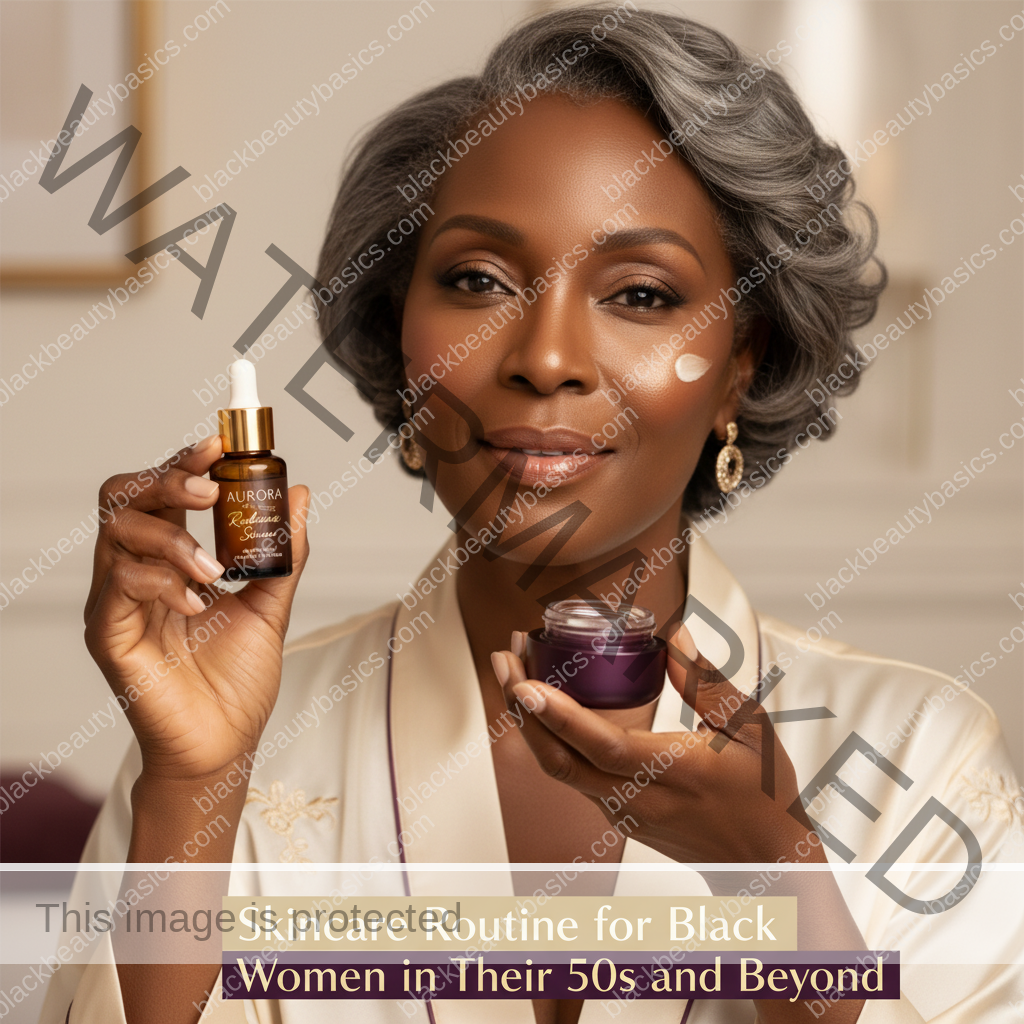
Skincare in your 50s and beyond is not about trying to make your face look like it did at 25. That pressure is loud, expensive, and often unkind. A better routine asks a more useful question: what does your skin need now to feel comfortable, protected, and cared for?
For Black women and people with richly melanated skin, this season can bring a mix of changes at once. Skin may feel drier. Texture may look different. Fine lines may settle around the eyes, mouth, or forehead. Dark marks may linger after irritation. Sunscreen may suddenly matter more because you are trying to protect glow, tone, and the results of every gentle step you take. None of that means your skin is failing. It means your routine deserves to mature with you.
If you want the larger map before you get specific, start with BBB’s routine design guide for Black women. This article is the focused next step for building a calm, elegant routine in your 50s, 60s, and beyond.
What Changes in Your 50s and Beyond
Many people notice that skin becomes less forgiving with age. A cleanser that used to feel fine may now leave your face tight. A serum that once gave a quick glow may now sting. A moisturizer that worked in your 40s may not last through the day. These changes can feel frustrating because they do not always arrive with a clear label. You may simply notice that your skin feels more easily depleted.
Part of this comes from changes in oil production, moisture retention, and skin renewal. Skin can become drier and slower to bounce back after irritation. The barrier, which is the outer layer that helps keep moisture in and irritants out, may need more support than it used to. When that barrier is stressed, the face may look dull, feel tight, or become more reactive to products that once felt harmless.
Melanin-rich skin also has its own after-story. A bump, scratch, rash, burn, or over-exfoliation moment can leave a dark mark that stays long after the original irritation is gone. That does not mean your skin is difficult. It means inflammation deserves respect. In this stage, prevention is just as important as correction. A calm routine can help reduce the number of new marks you have to manage later.
This is also a season where beauty advice can become deeply disrespectful. Mature skin is often spoken about as if it has lost value. BBB rejects that. Lines, texture, softness, and changing fullness are not flaws. The goal is not to erase evidence of living. The goal is to keep your skin healthy, comfortable, luminous, and supported in the life you actually have.
What to Stop Doing Before You Add More Products
The first adjustment is usually not buying a stronger treatment. It is removing the habits that quietly make mature skin more reactive. If your routine is built around stripping, burning, or chasing every new active, your skin may never get the steady support it needs to look its best.
Stop treating tightness like cleanliness
Tight skin after cleansing is not a sign that you did a better job. It is often a sign that your cleanser removed more than it needed to. In your 50s and beyond, that tight feeling can set off a pattern: the skin feels dry, you add a strong treatment to fix dullness, the treatment stings, the barrier gets stressed, and tone becomes more uneven. A cleanser should leave your face clean, not squeaky or tense.
Stop using exfoliation as the answer to every texture change
Texture is not always dead skin that needs to be scrubbed away. It can come from dryness, dehydration, product buildup, sun exposure, irritation, or natural skin changes. Over-exfoliating can make melanin-rich skin more vulnerable to post-inflammatory hyperpigmentation. If exfoliation leaves your skin shiny, tender, burning, or flaky, that is not progress. That is a signal to pause.
Stop layering too many treatments at once
Retinoids, acids, brightening serums, vitamin C, peptides, and exfoliating toners can all sound useful. The issue is not that these categories are bad. The issue is that too many at once can make it impossible to know what is helping and what is hurting. If your skin is already dry or sensitive, a crowded treatment routine may keep you in a cycle of irritation.
Stop skipping sunscreen because you do not burn easily
Black skin can still be affected by UV exposure. Sunscreen matters for dark marks, tone maintenance, texture, and long-term skin health. The problem is that many sunscreens have historically looked gray, purple, or greasy on deeper skin tones. That frustration is real. The answer is not to skip protection. The answer is to find a formula you can actually wear, then make it part of your morning routine.
If sunscreen tends to roll up or look heavy over your routine, BBB’s guide to layering serum, moisturizer, and SPF without pilling can help you troubleshoot the order and texture choices.
The Gentle Plan: A Routine That Supports Mature Melanin-Rich Skin
A strong routine in this stage is not necessarily complicated. It needs to cleanse without stripping, moisturize with intention, protect every morning, and use treatments carefully enough that your skin can tolerate them. Think of the routine as a rhythm, not a performance.
Morning step 1: Cleanse only as much as your skin needs
Some mornings call for a gentle cleanser. Other mornings, especially if your skin is very dry and you cleansed well the night before, a soft rinse may be enough. Pay attention to how your face feels when you wake up. If it feels oily, sweaty, or coated from the night before, cleanse gently. If it feels dry and calm, do not force a full wash just because a routine video said so.
Look for cleansers that are creamy, low-lather, or described as gentle. Avoid formulas that make your skin feel stripped, squeaky, or itchy. If you are comparing options, a search for gentle cream face cleanser can help you see the types of textures that often suit drier skin. Treat that as a product category to compare, not a promise that every formula will suit you.
Morning step 2: Add hydration before richness if your skin feels thirsty
Dryness and dehydration are not the same. Dry skin often needs more oil or richer moisturizer. Dehydrated skin often needs water-binding support. If your skin feels tight but also looks shiny, or if makeup catches on fine texture, a hydrating layer can help before moisturizer. This might be a simple hydrating serum, essence, or lightweight lotion with ingredients such as glycerin or hyaluronic acid.
Keep this step simple. You do not need five hydrating layers to prove you care about your skin. One comfortable layer that does not pill under moisturizer and sunscreen is enough. If it stings, stop using it. Hydration should feel soothing, not sharp.
Morning step 3: Choose a moisturizer that respects comfort
In your 50s and beyond, moisturizer often becomes the center of the routine. The right one can reduce tightness, soften the look of texture, help sunscreen sit better, and make the skin feel less reactive. The wrong one can feel greasy on top and dry underneath, or leave your face uncomfortable by midday.
Look for moisturizers that mention barrier support, ceramides, glycerin, shea butter, squalane, or other cushioning ingredients. You do not need all of them in one jar. You need a formula that your skin enjoys and that you can use consistently. If your skin is very dry, compare ceramide face moisturizer options and pay attention to texture, fragrance, and finish.
Morning step 4: Use sunscreen as tone protection, not punishment
Sunscreen should not feel like a chalky obligation. For Black women, it is part of protecting the work you are doing for tone, texture, and dark marks. A broad-spectrum SPF 30 or higher is a practical daily target. The best sunscreen is one you will wear enough of, reapply when needed, and not resent every morning.
If mineral sunscreens look ashy on you, you may prefer a sheer mineral, hybrid, or chemical formula. If chemical sunscreens sting your eyes, look for fragrance-free options or try different filters. If sunscreen feels greasy, reduce the layers underneath before blaming the SPF. To compare wearable options, you can explore sunscreen for dark skin SPF 30 searches and focus on finish, cast, and comfort.
Evening step 1: Remove the day without roughness
At night, the goal is to remove sunscreen, makeup, sweat, pollution, and hair product residue without leaving your face raw. If you wear makeup or water-resistant SPF, you may need a cleansing balm, oil cleanser, or micellar step before your regular cleanser. If you do not wear much product, one gentle cleanse may be enough.
Pay special attention to the hairline, jawline, and neck. Protective styles, scarves, bonnets, wigs, edge products, and moisturizers can all touch the skin. That does not mean you should scrub those areas aggressively. It means cleanse them with care so residue does not sit there overnight.
Evening step 2: Use treatment with a clear purpose
Treatment is where many routines get crowded. In this stage, it helps to choose one main goal at a time: smoother texture, tone support, fine-line care, breakouts, or dryness. A gentle retinoid may support texture and aging concerns. A brightening serum may support uneven tone. A mild exfoliant may help dullness. But using all of them every night is not automatically better.
Start low and slow, especially if your skin has become more sensitive. Use a treatment a few nights a week, then watch how your skin behaves. If you notice burning, peeling, roughness, or new dark marks after irritation, pause. Return to cleanser, moisturizer, and sunscreen until the skin feels steady again. For more signs that your skin is calming down, read BBB’s guide to signs your skin barrier is healing.
Evening step 3: Seal the routine with comfort
Your nighttime moisturizer can be richer than your morning one if your skin needs it. This is the moment to give your face a soft landing. If your cheeks, mouth area, or forehead get especially dry, you may use a little extra moisturizer there. If your skin is acne-prone, choose richness carefully and watch how your pores respond.
Do not judge the routine by whether it looks glamorous on the counter. Judge it by how your skin feels when you finish and how it behaves the next morning. A steady routine that you repeat is more valuable than an elaborate routine you can only manage twice a month.
How to Handle Tone, Texture, and Graceful Aging Without Shame
Uneven tone can feel emotionally loaded on richly melanated skin because dark marks often last longer than the original bump or irritation. It is understandable to want them gone. But your routine should not turn that desire into panic. Fast fading promises often push people toward harsh exfoliation, too many acids, or lightening language that treats deeper skin as something to correct.
The more respectful approach is to reduce new irritation, protect with sunscreen, support the barrier, and use tone-focused treatments patiently. Ingredients often used for tone support may include niacinamide, azelaic acid, tranexamic acid, vitamin C, licorice root, or gentle retinoids, depending on the formula and your skin’s tolerance. You do not need all of these. You need one or two well-chosen steps that fit your skin.
Texture also deserves nuance. Mature skin may have pores, fine lines, softness, and areas that catch light differently. Some texture is normal. If texture is rough because the skin is dry or irritated, barrier support may help more than exfoliation. If texture is from bumps, congestion, or a medical skin condition, a dermatologist may be the safer next step.
Graceful aging is not the same as doing nothing. It means caring for the skin without fighting your face. It means using sunscreen because you value your skin, not because you fear looking older. It means choosing moisture because comfort matters. It means letting treatments be tools, not punishments.
What to Do If Your Routine Is Not Working
If your routine is not working, do not assume your skin is the problem. The routine may be too strong, too inconsistent, too expensive to maintain, or too generic for your life. Troubleshooting begins with narrowing the variables.
If your skin burns or stings often, simplify for one to two weeks. Stop exfoliating, pause strong treatments, and use only gentle cleanser, moisturizer, and sunscreen. If the skin improves, the problem may have been intensity. If it does not improve, or if symptoms are painful, spreading, or persistent, professional guidance is worth seeking.
If your skin feels dry no matter what you use, look at cleansing first. Many people try to fix dryness with heavier creams while still washing with something too stripping. Then look at moisturizer texture, indoor air, climate, and whether you are applying moisturizer to slightly damp skin. Small changes can matter.
If dark marks are not improving, check the basics before adding more brightening products. Are you using sunscreen consistently? Are you still picking at bumps? Are new breakouts or irritation creating new marks? Are you giving the routine enough time? Hyperpigmentation on melanin-rich skin often requires patience. If marks are severe, widespread, or deeply distressing, a skin-of-color-aware dermatologist can offer options that home care cannot.
If your routine is too expensive, do not feel obligated to keep it because you already bought it. A routine should fit your real budget. BBB’s upcoming budget skincare routine guide can help you decide which steps matter most when money is tight, and the drugstore vs prestige skincare guide can help you separate useful splurges from beautiful packaging.
Frequently Asked Questions
1. Is it too late to start a skincare routine in my 50s or 60s?
No. It is not too late. Your skin can still benefit from gentler cleansing, better moisture, daily sunscreen, and carefully chosen treatments. The goal may not be dramatic overnight transformation, and that is okay. A good routine can still improve comfort, reduce unnecessary irritation, support a healthier-looking glow, and help protect against new dark marks. Start with the basics before you worry about advanced steps. Cleanse softly, moisturize well, and wear sunscreen in the morning. That foundation is meaningful at any age.
2. Do Black women really need sunscreen after 50?
Yes. Melanin offers some natural protection, but it does not make skin immune to UV damage. Sunscreen helps support tone, dark mark care, texture, and long-term skin health. This becomes especially important if you use treatments for tone, texture, or graceful aging because many of those routines work better when the skin is protected during the day. The key is finding a formula that looks good on your skin tone and feels comfortable enough to use consistently.
3. Should I use retinol or a retinoid at this age?
A retinoid can be helpful for some people, but it is not mandatory for everyone. If your skin tolerates it, a gentle retinoid may support texture, fine lines, and uneven tone over time. If your skin is very dry, sensitive, or already irritated, start slowly or speak with a dermatologist before adding it. Use it at night, avoid stacking it with too many exfoliating products, and keep moisturizer and sunscreen consistent. If it makes your skin burn, peel heavily, or develop new dark marks after irritation, pause.
4. What if my skin suddenly feels much drier than it used to?
Start by reviewing your cleanser and moisturizer. A stripping cleanser can make every moisturizer seem inadequate. Switch toward a gentle, creamy, non-stripping cleanse and use a richer moisturizer if your skin feels tight. You can also apply moisturizer while your skin is slightly damp. If dryness is severe, painful, cracking, or paired with a rash, it may need professional care. Do not keep exfoliating dry skin in hopes of forcing smoothness. Dryness usually needs support first.
5. Can I still treat dark spots without bleaching my skin?
Yes. Treating dark spots should not mean trying to lighten your overall complexion or chase a single uniform shade. A respectful approach focuses on preventing new irritation, protecting with sunscreen, and using tone-supportive ingredients patiently. The language matters. Your melanin is not the problem. The goal is to help post-inflammatory marks fade while keeping the surrounding skin healthy. If marks are stubborn, widespread, or connected to acne or another skin condition, a dermatologist can help create a safer plan.
6. How long should I wait before deciding a routine is working?
For comfort changes, you may notice improvement within days or a couple of weeks. Your skin may feel less tight, less reactive, or better moisturized. Tone and texture changes usually take longer. Dark marks can take months, especially on richly melanated skin. Give a simple routine enough time before changing everything. If a product irritates you, stop sooner. Patience does not mean tolerating pain. It means giving gentle, non-irritating steps a fair chance.
7. When should I see a dermatologist?
See a dermatologist if irritation is painful, spreading, infected-looking, or persistent; if acne, rashes, or discoloration are affecting your quality of life; or if over-the-counter routines keep making things worse. If possible, look for a provider experienced with skin of color. Professional help is not a failure. It can protect your skin, reduce guesswork, and help you avoid harsh trial-and-error routines that create more dark marks.
What to Do Next
If you are rebuilding your routine, choose one starting point. Maybe that is replacing a stripping cleanser. Maybe it is finding a moisturizer that lasts through the day. Maybe it is finally choosing a sunscreen that does not make you look gray. Do not overhaul everything at once. Mature skin often responds better to steadiness than surprise.
If you are coming from your 40s routine and want to compare what has changed, read BBB’s skincare routine for Black women in their 40s. If you are struggling with product order, revisit the layering guide. If your skin feels reactive, start with the barrier healing guide.
Your face does not need to look untouched by time to be beautiful. It deserves care that honors where you are now: wise enough to know that harshness is not power, discerning enough to choose what actually helps, and soft enough with yourself to keep going without shame.
Related next steps
Related posts:
 Skincare Routine for Black Women in Their 20s
 Skincare Routine for Black Women in Their 30s
 Skincare Routine for Black Women in Their 40s
 Beyond the Shade: Why Sunscreen is a Non-Negotiable for Black Women
 Night Skincare Routine for Melanin-Rich Skin When You Are Too Tired for a Full Routine
 Best Minimalist Skincare Routine for Black Women Who Hate Complicated Routines