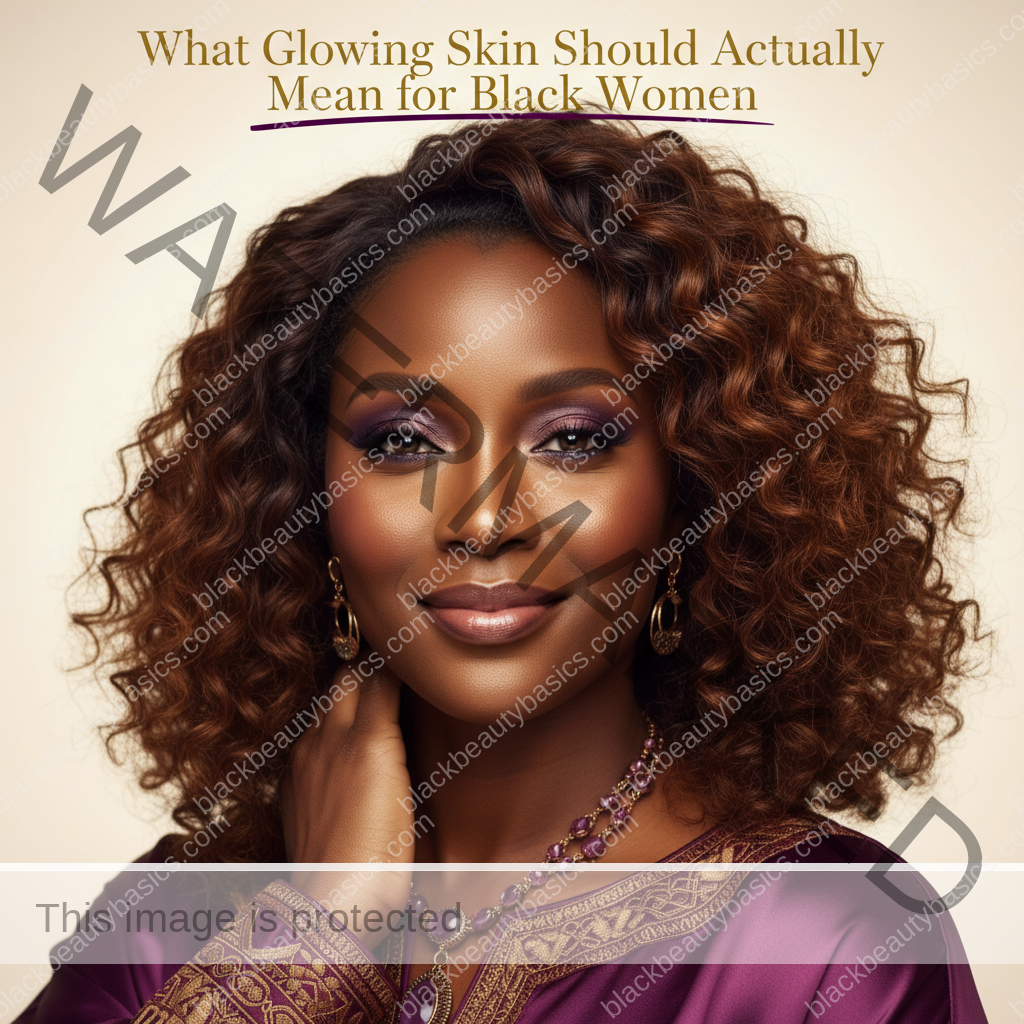
“Glowing skin” should not mean perfect skin. It should not mean lighter skin, poreless skin, filtered skin, or skin that has been polished until every trace of real life disappears. For Black women and people with richly melanated skin, the phrase has been used in ways that can quietly slide into tone shame, texture pressure, and product anxiety. Too often, glow becomes another standard we are expected to chase instead of a sign that our skin feels cared for.
Let us define it differently. Glowing skin can mean skin that feels comfortable after cleansing. Skin that is protected from daylight. Skin that is not being burned, scrubbed, or over-treated in the name of progress. Skin that can have pores, texture, dark marks, oil, dryness, and still be worthy of softness. Glow should be about health, resilience, and relationship, not performance.
This guide is for the reader who has ever looked at her face and wondered why it does not match the glossy skin she sees online. It is also for the reader who is tired of being sold a new serum every time she feels human. If you need the larger routine map, start with BBB’s skincare routine design guide. Here, we are going to talk about what glow should actually mean for Black women, how to pursue it safely, and how to stop letting beauty language make your skin feel like a problem.
Why the Word “Glow” Can Feel Complicated
Glow sounds positive. It sounds warm, radiant, and aspirational. But in beauty culture, it can carry hidden pressure. A word that should mean vitality can become a demand for smoothness, brightness, youth, evenness, and constant visibility. When that standard is filtered through colorism and texturism, it can become especially heavy for Black women.
Some glow messaging praises deeper skin only when it looks reflective, perfectly even, and untouched by acne, hyperpigmentation, dryness, or texture. That is not celebration. That is conditional approval. Richly melanated skin deserves language that honors its depth without implying it must be corrected into uniformity.
There is also the problem of lighting. Online glow is often created by soft boxes, front-facing light, smoothing filters, makeup, editing, and camera angle. Real skin has movement. It looks different in morning light, bathroom light, office light, car mirrors, and flash photos. If you compare your real face to a controlled image, your skin will almost always seem like it is falling short.
Then there is the product loop. If glow is treated as a constant visual state, every normal change becomes a shopping cue. Dull today? Buy a brightener. Rough today? Buy an exfoliant. Oily today? Buy a mattifier. Dark mark still visible? Buy something stronger. This can lead to over-testing, irritation, and a routine that becomes more about anxiety than care.
For melanin-rich skin, that loop can be costly. Harsh exfoliation, picking, burning products, and constant switching can trigger irritation that leaves post-inflammatory hyperpigmentation. In other words, chasing glow too aggressively can create the very concerns that make you feel farther from it.
BBB’s position is simple: glow should never require shame. It should never require pain. It should never ask Black women to treat their natural tone, texture, or visible skin history as something to erase.
What Glowing Skin Should Not Mean
Before we define glow in a healthier way, we have to remove the meanings that do not belong.
Glow should not mean lighter skin
This matters. Bright, radiant, clear, and even should never be code for lighter. Melanin-rich skin can glow in every shade: deep brown, rich espresso, golden brown, red-brown, neutral brown, blue-black, and everything in between. The goal is not to move your complexion closer to someone else’s standard. The goal is to support your skin where it is.
Glow should not mean no dark marks
Dark marks are common on richly melanated skin, especially after acne, irritation, bites, shaving bumps, friction, or eczema flares. They can be frustrating, but their presence does not cancel your beauty. A person can have dark marks and still have cared-for skin. Fading marks safely is a valid goal. Hating your face until they are gone is not required.
Glow should not mean zero texture
Skin has pores. Skin has lines. Skin has hair follicles. Skin has areas that reflect light differently. Texture is not automatically a flaw. If texture is related to irritation, acne, or a condition you want help managing, that is one thing. But normal skin texture does not need to be treated like failure.
Glow should not mean constant shine
Some people confuse glow with oiliness. Others try to mattify every hint of shine until the skin looks flat. Both extremes can be frustrating. Healthy glow is about balance and comfort, not looking wet all day or powdering yourself into dullness. Your skin can be luminous without being greasy.
Glow should not mean expensive skincare
A routine does not become more respectful because it costs more. Luxury products can be beautiful, but price does not guarantee compatibility. A simple, affordable routine that keeps your skin comfortable is more valuable than a prestige shelf that irritates you or makes you afraid to run out.
Glow should not mean ignoring medical concerns
If your skin is painful, inflamed, infected-looking, persistently irritated, or deeply affecting your quality of life, glow language is not enough. You deserve professional care, ideally from someone familiar with skin of color. Self-love does not mean pretending a problem does not need support.
A Better Definition of Glow for Black Women
So what should glowing skin mean? At BBB, we define it through function, comfort, and care.
Glow means your skin feels comfortable
Comfort is underrated. If your skin no longer burns after cleansing, no longer feels tight all morning, and no longer makes you dread applying moisturizer, that is glow. Comfort means the barrier is being respected. It means your routine is not asking the skin to recover from daily punishment.
Glow means your barrier is supported
A supported barrier helps the skin hold water, tolerate products, and recover from everyday stress. This is especially important when you are managing dark marks or irritation. Before chasing brightness, ask whether your barrier is calm. BBB’s guide to signs your skin barrier is healing can help you recognize progress that is not always dramatic in photos.
Glow means fewer new irritation cycles
For melanin-rich skin, preventing new inflammation is a major part of maintaining tone. If you are getting fewer new bumps from over-cleansing, less irritation from products, and less picking because your skin feels calmer, that is meaningful progress. It may not look like a viral transformation, but it protects your future skin.
Glow means your routine is repeatable
The best routine is not the most complicated one. It is the one you can repeat with your actual schedule, budget, climate, and energy level. A routine that works only during a perfect self-care Sunday is not enough. If you want a simpler structure, the minimalist skincare routine may be a better match than another product-heavy trend.
Glow means protection, not just correction
Correcting concerns matters, but protection is the foundation. Sunscreen during daylight exposure, gentle cleansing, consistent moisture, and reducing irritation all support glow. This is not glamorous advice, but it is the kind that helps skin stay resilient over time.
Glow means your skin can still look like skin
This is the heart of it. Glowing skin can have pores. It can have old marks. It can have a shiny T-zone. It can have a dry patch during winter or a breakout before your cycle. Your skin does not have to be visually silent to be healthy, worthy, or beautiful.
How to Build a Routine Around Real Glow
A real-glow routine is not about doing the most. It is about choosing steps that support the skin without creating new problems.
Start with the baseline
Your baseline is cleanser, moisturizer, and sunscreen during daylight exposure. That may sound too simple, but it is the structure that allows every other product to make sense. If cleansing leaves you tight, moisturizer stings, or sunscreen pills every morning, adding a brightening serum may not solve the real issue.
If you recently tried too many products and lost track of what caused irritation, pause and use BBB’s routine reset guide. A reset can help you return to comfort before you chase new results.
Choose one treatment goal at a time
Real glow does not require treating every concern every morning. Pick one priority: acne, dark marks, dehydration, texture, or barrier support. Then choose products around that job. When you stack too many goals at once, you increase the risk of irritation and make it harder to know what is working.
Use sunscreen as care, not punishment
Sunscreen is sometimes discussed with fear, but for BBB, it is an act of protection. It helps reduce the chance that dark marks become more noticeable from daylight exposure. The right sunscreen should work with your skin tone and your life. If it looks gray, pills, or feels unbearable, the issue is product fit, not personal failure.
Let moisture be practical
Moisture is not only about looking dewy. It helps reduce tightness, supports the barrier, and can make makeup sit better. Oily skin can need moisture. Acne-prone skin can need moisture. Melanin-rich skin that looks ashy may need moisture before it needs exfoliation.
Stop using pain as proof
If a routine burns and makes you anxious, it is not a glow-up. It is a red flag. Effective skincare can be active without being punishing. Your skin should not have to endure daily discomfort to be considered cared for.
Make room for your real life
Climate, work schedule, budget, stress, sleep, hair routines, makeup, and family responsibilities all affect skincare. A routine that ignores your life will not hold. Glow should not require pretending you have unlimited time, money, or energy. It should fit the life you actually live.
How to Know You Are Chasing Glow in a Harmful Way
Sometimes the pursuit of glow starts healthy and quietly becomes stressful. Watch for these signs.
You are buying faster than you are learning
If every frustration leads to a purchase, the routine may be driven by anxiety. Slow down. Read your skin before adding another product.
You keep using products that hurt
Repeated burning, stinging, peeling, or tightness is not something to romanticize. Pause and simplify. If irritation continues, get help.
You only feel beautiful when your tone looks perfectly even
Even tone can be a skincare goal, but it should not be the condition for self-respect. Dark marks can be treated without making them the center of your worth.
You compare your bare face to edited images
That comparison is not fair. Your real skin is doing real biological work. A filtered image is doing visual performance.
You are afraid to simplify
If a shorter routine feels like giving up, pause. Sometimes fewer steps are exactly what your barrier needs. Simplicity can be disciplined, elegant, and effective.
Your routine makes you feel watched by yourself
Skincare should not turn every mirror into a performance review. If your routine increases shame more than care, it needs emotional adjustment, not just product adjustment.
Frequently Asked Questions
1) Can Black women have glowing skin with dark marks?
Yes. Dark marks do not cancel glow. You can have old post-acne marks and still have skin that is hydrated, protected, comfortable, and healing. It is completely valid to want marks to fade, but your skin does not have to be perfectly even before it is worthy of care or confidence.
2) Does glowing skin mean my skin should look lighter?
No. Glow is not lightness. Glow is about vitality, comfort, reflection, and care within your natural skin tone. Any messaging that makes lighter skin seem like the goal is not aligned with BBB’s values. Deep skin can be radiant without being corrected toward a lighter standard.
3) What if my skin is oily but still looks dull?
That can happen. Oiliness and dehydration can exist at the same time. Your skin may have surface shine while still needing water, gentle cleansing, or barrier support. If this pattern feels familiar, read BBB’s oily-and-ashy skin routine for a more targeted plan.
4) Do I need expensive products to get glowing skin?
No. A consistent, comfortable routine matters more than prestige pricing. Spend first on the basics your skin uses every day: cleanser, moisturizer, and sunscreen. If your budget is tight, BBB’s simple skincare routine on a budget can help you prioritize without shame.
5) How do I know if I am overdoing my routine?
You may be overdoing it if your skin burns often, feels tight after most steps, flakes, breaks out after every new addition, or if you cannot tell what any product is doing. Emotional signs count too: dread, constant checking, and panic buying are all clues that the routine needs to calm down.
6) Should I focus on glow or barrier repair first?
Barrier repair comes first. A calm barrier helps the skin tolerate treatment, hold moisture, and reduce new irritation. If you chase glow while the barrier is stressed, you may create more inflammation and more marks. Comfort is not less glamorous than glow. It is the foundation of it.
7) When should I see a dermatologist?
See a dermatologist if acne, irritation, discoloration, itching, pain, or sensitivity is persistent, worsening, or affecting your quality of life. If possible, choose someone experienced with skin of color. Professional support can help you treat concerns safely without relying on harsh trial and error.
What to Do Next
Redefine glow before you buy another product. Ask yourself: does my skin feel comfortable after cleansing? Can I wear sunscreen consistently? Am I creating fewer new irritation marks? Does my routine fit my real life? Do I feel more supported by skincare or more judged by it?
If your routine feels chaotic, start with the reset guide. If you want fewer steps, move to the minimalist routine. If your barrier is recovering, learn the signs before adding more actives. Let your next skincare decision come from clarity, not pressure.
Your skin does not have to be poreless, spotless, or lighter to glow. Your glow can be rich, deep, textured, lived-in, protected, and completely yours.
Related next steps
Related posts:
 When Ingrowns Mean It’s Time to See a Derm or Change Methods
 Drugstore vs Prestige Skincare for Melanin-Rich Skin: What Actually Matters
 Collagen, Biotin, and Hair Vitamins for Black Women: What Science Actually Says
 Achieving a Healthy and Glowing Complexion – The Role of Skincare Products
 Achieving a Healthy and Glowing Complexion – The Role of Skincare Products
 Nude, Not Washed Out: The Best Nude Lipsticks That Actually Flatter Melanin-Rich Skin