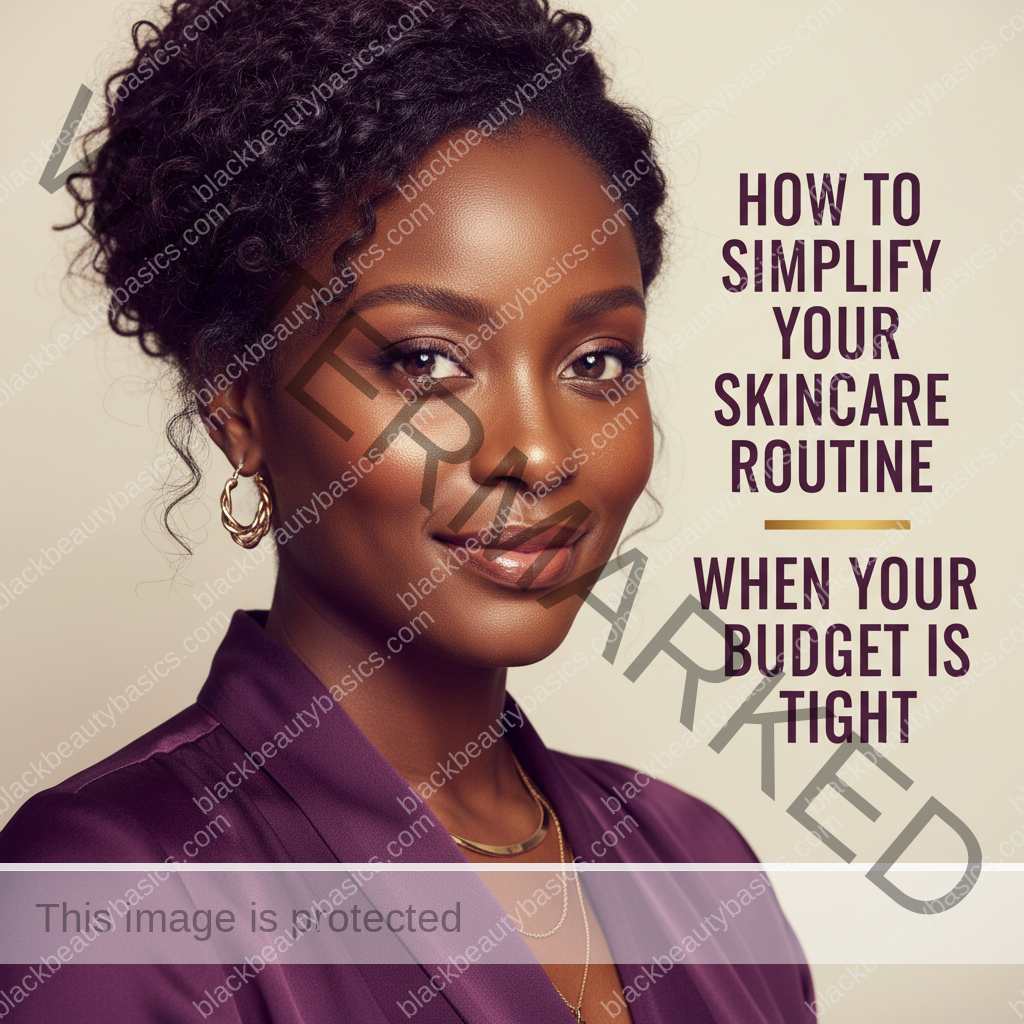
When your budget is tight, skincare advice can start to feel insulting. It tells you to buy the cleanser, the toner, the essence, the vitamin C, the retinoid, the exfoliant, the barrier cream, the sunscreen, and the backup sunscreen, as if real life does not exist. Rent exists. Groceries exist. Children, bills, debt, emergencies, and tired mornings exist. Your skin still deserves care, but care should not require panic spending.
For Black women and people with richly melanated skin, simplifying a routine is not just about owning fewer products. It is about protecting the skin barrier, preventing avoidable irritation, and keeping dark marks from becoming worse because you are trying too many things at once. A smaller routine can be more respectful than a crowded one if every step has a clear job.
If you need the full routine map, start with BBB’s skincare routine design guide for Black women. This article is the budget-focused version: what to keep, what to pause, what to buy first, and how to stop feeling like your skin is failing because your shelf is not full.
Why Budget Skincare Gets Emotionally Complicated
Skincare is not only a product category. It can become a place where hope, frustration, shame, and comparison all meet. When money is tight, every purchase feels heavier. A cleanser that does not work is not just disappointing; it can feel like wasted money. A serum that irritates you can feel personal. A sunscreen that leaves a cast can make you wonder why even the “basic” advice does not seem built with your skin in mind.
That frustration is real. Black women have often had to work harder to find products that respect deeper skin tones, textured hair routines, hyperpigmentation concerns, and real budgets. The beauty industry may celebrate melanin in campaigns while still leaving people to guess which formulas will actually sit well on brown and deep skin. That gap can lead to overbuying because you are searching for the one product that finally makes things feel easy.
A tight budget can also make people keep products that are not serving them. You might continue using a stripping cleanser because it is already in the bathroom. You might keep a strong acid because it was expensive. You might stretch a sunscreen you dislike because you do not want to admit it was a bad buy. BBB’s position is simple: your skin should not have to pay for a product’s price tag. If something is irritating you, the money has already been spent. Do not spend your skin barrier too.
The budget-friendly routine starts with a calmer mindset. You are not building a perfect shelf. You are building a repeatable baseline. The baseline should cleanse gently, moisturize enough, protect in the morning, and leave room for one targeted treatment only when the essentials are stable. That is not settling. That is strategy.
What to Stop Doing When Money Is Tight
The fastest way to protect both your face and your wallet is to stop the habits that create more confusion. Simplifying does not mean neglecting your skin. It means refusing to let marketing turn every concern into a separate purchase.
Stop buying before you name the problem
Before buying anything, finish this sentence: “I need this product because my skin is…” Tight after cleansing? Getting new dark marks from breakouts? Looking dull because sunscreen is pilling? Feeling dry by noon? Those are different problems. They do not all need the same product. Naming the problem keeps you from buying a serum when the real issue is a harsh cleanser, or buying a prestige moisturizer when the real issue is that you skip sunscreen.
Stop replacing the whole routine at once
A full reset can feel exciting, but it is risky. If you replace cleanser, moisturizer, sunscreen, and treatment in one week, you will not know what helped or what caused irritation. Melanin-rich skin can hold onto the evidence of irritation through post-inflammatory hyperpigmentation, so trial-and-error needs to be gentle. Change one product at a time when possible. Let your skin give you information before you spend again.
Stop treating actives as the heart of the routine
Actives can be useful, but they are not the foundation. Retinoids, exfoliating acids, vitamin C, and brightening serums tend to get attention because they sound transformative. But if your cleanser strips, your moisturizer is not enough, and your sunscreen is inconsistent, actives may irritate more than they help. Budget skincare should make the basics strong first. Treatment comes later, with a clear purpose.
Stop believing a low price means low worth
Affordable products are not automatically inferior. A simple cleanser that leaves your face comfortable is valuable. A plain moisturizer that keeps your skin from feeling tight is valuable. A sunscreen you actually wear is valuable. Prestige can be beautiful, and sometimes it is worth it, but price is not proof of care. BBB’s drugstore vs prestige skincare guide goes deeper on how to compare value without letting hype make the decision.
Stop shopping when you are upset with your skin
This one is tender, but important. Buying products while you feel ashamed, panicked, or angry at your face often leads to harsh choices. You may reach for stronger exfoliation, more brightening products, or a routine that promises fast results. Take a pause first. If your skin is irritated, simplify. If you are breaking out, protect the barrier and consider whether you need professional help. If you are dealing with dark marks, remember that prevention and patience matter. Your body deserves care, not punishment.
The Budget Routine: What to Keep, What to Buy, What to Pause
A tight-budget routine should be built around product roles, not product count. For most people, the core routine is cleanser, moisturizer, sunscreen, and one optional treatment. That is enough structure to care for the skin without turning every paycheck into a product experiment.
Step 1: Keep or choose a gentle cleanser
Your cleanser should remove sweat, sunscreen, makeup residue, oil, and daily buildup without leaving your face tight. If you already own a cleanser that does this, keep it. Do not replace it just because someone online has a prettier one. If your cleanser leaves your skin squeaky, itchy, or dry, it may be worth replacing before you buy any serum.
Look for words like gentle, non-stripping, creamy, hydrating, or fragrance-free. A cleanser does not need to be fancy because it is rinsed off, but it does need to respect your barrier. If you are comparing affordable options, a search for affordable gentle face cleanser can help you see the kind of category to look for. Compare by skin feel, not by promises of instant glow.
Step 2: Make moisturizer do more of the work
Moisturizer is often the most underrated budget step. A good moisturizer can reduce tightness, soften roughness, help the barrier recover, and make sunscreen sit better. If your skin is dry, irritated, or dull, do not rush straight to acids. Ask whether your moisturizer is actually giving your skin enough support.
For oily or acne-prone skin, a lightweight lotion or gel-cream may be enough. For dry or mature skin, a richer cream may be more useful. If your skin is dehydrated, you may need a hydrating layer or a moisturizer with humectants such as glycerin. If you are not sure what kind of moisture your skin needs, BBB’s moisturizer guide for acne-prone and dehydrated skin can help you sort it out without buying three jars at once.
Step 3: Treat sunscreen as a non-negotiable budget priority
Sunscreen can be frustrating on deeper skin tones because some formulas leave a gray cast, feel greasy, or pill under makeup. Still, it is one of the most important steps if you care about dark marks, tone, and long-term skin health. If you are spending money on brightening products but skipping sunscreen, your routine is working against itself.
The right sunscreen is the one you will wear enough of. It may be drugstore. It may be mid-range. It may take a little searching. Focus on broad-spectrum SPF 30 or higher, wearable finish, and comfort. If you need a place to compare categories, look through affordable sunscreen for dark skin SPF 30 options and pay close attention to cast, finish, and reviews from people with deeper skin tones.
Step 4: Choose only one treatment goal at a time
Once the basics feel steady, choose one treatment goal. Maybe it is post-acne marks. Maybe it is dullness. Maybe it is texture. Maybe it is breakouts. Do not try to treat every concern with a different active at the same time. That is expensive, and it can be irritating.
If dark marks are the main issue, look for gentle tone-supportive ingredients and be consistent with sunscreen. If texture is the issue, first decide whether it is dryness, buildup, bumps, or irritation. If breakouts are the issue, keep the routine simple enough that you can tell what is helping. Treatment should enter the routine as a tool, not as a panic response.
Step 5: Use what you already own with more intention
Before buying anything, line up your current products and assign each one a job. Cleanser. Moisturizer. Sunscreen. Treatment. If a product does not have a clear job, set it aside. If two products do the same job, choose the gentler or more wearable one. If something stings or leaves your skin worse, do not keep forcing it because you paid for it.
This is also where you can reduce waste. A facial moisturizer that is too heavy may work on the neck or body if it does not irritate you. A cleanser that is too drying for your face may not be worth using anywhere if it leaves you uncomfortable. Be practical, but do not make your skin endure a bad product just to feel financially responsible.
How to Spend Less Without Losing Results
Budget skincare works best when you stop thinking in hauls and start thinking in priorities. The goal is to spend where the routine breaks down, save where the routine already works, and avoid buying products that duplicate each other.
Use the baseline-first rule
If you can only improve one thing this month, choose the step that affects your skin every day. For many people, that is cleanser, moisturizer, or sunscreen. A better cleanser may reduce dryness. A better moisturizer may calm the barrier. A better sunscreen may protect dark marks and make your routine more consistent. A serum can wait if the baseline is uncomfortable.
Use the one-month test
When you add a new product, give yourself enough time to learn from it unless it irritates you. For cleanser and moisturizer, you may know quickly whether the feel is right. For tone and texture, results take longer. Keep notes if that helps: what changed, what felt better, what irritated you, and whether the product fits under sunscreen or makeup.
If products keep pilling, the issue may be layering rather than price. BBB’s guide to layering serum, moisturizer, and SPF without pilling can help you fix the routine order before you replace everything.
Stop buying backups before you know a product works
Sales can make people buy three of a product they have not truly tested. That is not saving money if the product breaks you out or leaves a cast. Buy one. Test it. Repurchase only after you know it fits. A discount is only a discount when the product becomes useful in your real routine.
Make a small no-buy rule for duplicates
A no-buy does not have to be dramatic. You can simply decide not to buy another moisturizer until the current one is finished, not to buy a second brightening serum until you have used the first one consistently, or not to buy a trending product unless it replaces something. Boundaries make your routine calmer.
Let the minimalist routine be enough for a season
There are seasons where your routine needs to be basic because life is full. That is not failure. If cleanser, moisturizer, and sunscreen are all you can afford and repeat right now, that is still care. BBB’s minimalist skincare routine can help you keep the structure steady while you decide what, if anything, deserves to be added later.
What If You Already Bought Too Much?
If your cabinet is full but your skin is confused, the answer is not to finish everything at once. That creates more irritation and more uncertainty. Start by separating your products into three groups: essentials, optional treatments, and products that caused problems.
The essentials are the products your skin tolerates: cleanser, moisturizer, sunscreen. The optional treatments are products that may be useful later but do not need to be used right now. The problem products are anything that burns, strips, causes repeated breakouts, or makes you dread your routine. You do not need to keep applying those to prove the money was not wasted.
For two weeks, use the smallest comfortable routine. Watch for less tightness, less stinging, fewer new bumps, or less anxiety around your skincare. Those are signs that simplification is helping. If your skin barrier has been stressed, BBB’s guide to signs your skin barrier is healing can help you recognize progress that is not dramatic but still meaningful.
If you still want to use a treatment product later, reintroduce only one. Use it slowly and watch how your skin responds. If it irritates you again, it may not be the right fit. Let that be information, not a moral failure.
Frequently Asked Questions
1. What are the only skincare products I really need when money is tight?
For most people, the essentials are a gentle cleanser, a moisturizer that keeps the skin comfortable, and a broad-spectrum sunscreen for daytime. If you wear makeup or water-resistant sunscreen, you may also need a makeup-removing step, but it does not have to be expensive. Treatment products can wait until the basics are steady. If acne, discoloration, or irritation is severe, professional help may be more useful than buying multiple over-the-counter products.
2. Should I stop using serums if my budget is tight?
Not always. If a serum is helping, does not irritate you, and fits your budget, you can keep it. But serums are not more important than cleanser, moisturizer, and sunscreen. If your budget forces a choice, keep the basics first. A brightening serum cannot do its best work if you are skipping sunscreen, and a texture serum may irritate you if your barrier is already dry or stressed. Use serums for clear goals, not because every routine online includes one.
3. Is cheap skincare bad for Black skin?
No. Affordable skincare can be very good for Black skin when the formula is gentle, wearable, and suited to your concern. The problem is not cheap versus expensive. The problem is whether the product strips, irritates, leaves a cast, causes buildup, or creates new inflammation. Melanin-rich skin deserves formulas that respect the barrier at every price point. Judge by performance on your skin, not by prestige.
4. What should I buy first if I can only replace one product?
Replace the product that is causing the most routine damage. If your cleanser leaves your face tight, start there. If your moisturizer disappears too quickly and your skin feels dry all day, start there. If you skip sunscreen because it looks gray or pills, start there. The best first purchase is the one that makes the rest of the routine easier to repeat.
5. How do I care for dark marks on a budget?
Start by preventing new irritation. Do not pick, scrub aggressively, or use harsh DIY treatments. Keep sunscreen consistent because UV exposure can make the look of dark marks more stubborn. Once the basics are steady, you can consider one tone-supportive treatment if your skin tolerates it. Dark marks on richly melanated skin often take time, so avoid products that promise overnight results. If marks are severe or connected to ongoing acne, a dermatologist can help.
6. How long should I simplify before adding something new?
Give a simple routine at least one to two weeks if your skin is irritated, unless symptoms are painful or worsening. You are looking for signs of comfort: less stinging, less tightness, fewer new reactions, and a routine that feels easier to repeat. For dark marks or texture, visible changes can take longer. Once the skin feels steadier, add only one product at a time so you can tell what is helping.
7. What if I feel embarrassed that I cannot afford a big routine?
Please do not let the beauty industry turn your budget into shame. A large routine is not proof that someone cares for herself better. A smaller routine can be thoughtful, elegant, and effective when the steps are chosen well. Your skin does not need a luxury shelf to be worthy of softness. It needs care that fits your real life. That includes your money, your time, your energy, and your peace.
What to Do Next
Start with a product audit. Put your cleanser, moisturizer, sunscreen, and treatments in front of you. Name each one’s job. Keep the products that are comfortable and useful. Pause the products that duplicate each other. Stop using anything that consistently irritates you.
If your routine feels too crowded, read the routine reset guide. If you are unsure whether a higher-priced product is worth it, go to the drugstore vs prestige guide. If your goal is a calmer routine overall, return to the routine design pillar.
A budget routine is not a lesser routine. It can be clear, protective, and deeply respectful. Let it be simple enough to repeat, gentle enough to trust, and honest enough to fit the life you are actually living.
Related next steps
Related posts:
 Budget vs High‑End Skincare Routines for Black Women (What to Save vs Splurge On)
 Budget-Friendly Skincare Products for Women of Color
 Budget-Friendly Skincare Products for Women of Color
 Night Skincare Routine for Melanin-Rich Skin When You Are Too Tired for a Full Routine
 Skincare Routine for Black Women in Their 30s
 Skincare Routine for Black Women in Their 40s