
If your skin suddenly stings when you wash it, feels tight after products that used to be fine, looks dull no matter how much moisturizer you use, or seems to turn every tiny irritation into a dark mark, your skin is not being dramatic. It may be asking for a barrier reset. For Black women and people with richly melanated skin, a damaged skin barrier can feel especially frustrating because irritation often leaves evidence behind: deeper discoloration, stubborn post-inflammatory hyperpigmentation, rough texture, and that tired-looking cast that makes you want to try even more products.
This guide is not here to shame you for exfoliating, using actives, chasing glow, or trying to fix a concern that bothered you. Most barrier damage happens because someone was trying hard to take care of their skin with advice that did not account for deep skin, sensitivity, climate, stress, prescriptions, hard water, seasonal shifts, or real life. Here is the calmer truth: you can rebuild a damaged skin barrier, but the path usually starts with doing less, choosing gentler support, and giving your skin enough quiet time to prove it can recover.
Use this as your steady starting point for a simpler skincare reset. It explains what your barrier does, what can damage it, what to pause, what to keep, and how to rebuild a routine that feels steady instead of frantic. If you want the shorter decision tool after reading, keep the BBB simple skincare reset checklist close as your quick reference.

What your skin barrier does, in plain language
Your skin barrier is the outer protective layer that helps keep water in and irritants out. Think of it as the part of your skin that decides whether the outside world gets to come all the way in. When the barrier is steady, your skin usually feels more comfortable. Products are less likely to sting. Moisturizer seems to last longer. Your face may still have texture, pores, oil, or old marks, because normal skin is still normal, but it does not feel constantly defensive.
The barrier is made of skin cells and lipids that work together like bricks and mortar. The cells give structure. The lipids help seal moisture in. When that structure is disrupted, water escapes more easily, so your skin may feel dry or tight even if you are applying moisturizer. Ingredients that were once easy to tolerate may burn. Cleansers can feel harsher. Sweat, wind, fragrance, acids, retinoids, acne treatments, and even plain water may suddenly feel like too much.
On melanin-rich skin, barrier damage matters for one more reason: inflammation can wake up pigment. A small breakout, scratch, burn, rash, or irritated patch can leave a dark mark that lingers long after the original problem calms down. This does not mean your skin is flawed. It means your melanocytes are responsive. The goal is not to force your complexion into one flat shade. The goal is to reduce avoidable irritation so your skin has fewer reasons to create new marks while old ones fade at their own pace.
A healthy barrier also helps you make better decisions about active ingredients. Many people blame themselves when vitamin C, exfoliating acids, retinoids, or acne treatments do not work the way they expected. Sometimes the issue is not that the ingredient is bad. Sometimes the skin underneath is too irritated to receive it well. If your barrier is already stressed, even useful ingredients can feel like too much pressure.
If you are trying to decide whether your skin is truly barrier-damaged or simply dry, dehydrated, oily, or reactive, the deeper explainer on dry versus dehydrated skin on deep tones is a useful next read. That distinction matters because dry skin needs more oil-rich support, dehydrated skin needs better water retention, and barrier-damaged skin often needs both plus a break from irritation.
Signs your barrier may be damaged
A damaged barrier does not look the same on everyone. Some people see visible redness. On deeper skin tones, redness may show up more subtly as warmth, tenderness, swelling, shadowy patches, a gray cast, or areas that look darker after irritation. The feeling of the skin often tells the story before the mirror does.
Common signs include stinging when you apply products, tightness after washing, sudden sensitivity, rough patches, flaking, itchiness, burning after sunscreen, makeup clinging to dry areas, and breakouts that seem tied to irritation rather than normal oiliness. You may also notice that products sit on top of your skin but never make it feel comfortable. That can happen when the barrier is not holding water well.
Another clue is routine fatigue. If you have added more steps, more acids, more brightening products, more spot treatments, and more masks, but your skin looks angrier, your routine may be doing too much. The guide on signs your skincare routine is doing too much can help you sort that out without blaming yourself.
Barrier damage is also common after over-exfoliation, prescription acne treatments, strong retinoids, harsh cleansers, cold weather, hard water, stress, frequent product switching, or trying to fade hyperpigmentation too aggressively. The pattern is often the same: your skin starts giving you warning signals, but the internet tells you to push through, purge, exfoliate more, or add another corrective product. BBB does not believe in pushing through pain for beauty. If your current routine makes your skin sting and your anxiety spike, that is not a glow-up signal. It is a reason to pause and simplify.
There is also an emotional sign worth naming. If you feel afraid to wash your face because you do not know what will burn today, that matters. If you keep buying products because your skin feels out of control, that matters. A barrier reset is not only about ingredients. It is also about rebuilding trust with your skin so your routine stops feeling like a nightly negotiation.

What to stop while your skin is recovering
The fastest way to make a barrier reset harder is to keep asking your skin to tolerate the same pressure that overwhelmed it. This is the part where many people struggle, because pausing actives can feel like giving up on dark spots, acne, texture, or glow. It is not giving up. It is making sure your skin is stable enough to benefit from treatment later.
Pause exfoliating acids and scrubs
If your skin burns, flakes, or feels raw, pause AHAs, BHAs, peels, exfoliating toners, exfoliating pads, and physical scrubs. That includes products marketed as gentle if your skin is currently reacting. You can return to exfoliation later, but not while your skin is asking for a break. When you are ready, use the guide to reintroducing exfoliation after overdoing acids so you do not jump back in too quickly.
Pause brightening stacks
It is understandable to want dark marks gone. But stacking brightening serums, exfoliants, vitamin C, retinoids, and spot treatments on irritated skin can keep the inflammation cycle alive. If the product is meant to push, resurface, tingle, peel, or accelerate, it probably belongs in the pause pile until your skin feels steady again.
This is especially important if you are treating post-inflammatory hyperpigmentation. Dark spots often make us feel urgent, but urgency can lead to over-treatment. The quiet strategy is usually better: calm the skin, protect it from UV exposure, then reintroduce targeted treatment slowly. Your dark spots are not proof that you failed. They are part of how melanin-rich skin responds after inflammation.
Stop chasing the squeaky-clean feeling
A cleanser that leaves your face tight may be removing more than oil. It may be stripping the lipids your barrier needs. During repair, avoid harsh foaming cleansers, aggressive double cleansing, hot water, and washcloth scrubbing. If cleansing is the step that starts the burning, move toward the criteria in the gentle cleanser guide for dark skin that feels tight after washing.
Stop testing new products every few days
Product hopping makes it almost impossible to know what is helping or hurting. During a reset, your routine should be boring enough to track. That does not mean forever. It means your skin needs a clear baseline before you ask it to evaluate something new. Give each supportive change enough time to show whether it helps.
Be careful with fragrance and essential oils
Fragrance is not automatically evil, and fear-based skincare is not BBB’s style. But when your skin is burning, itchy, or reactive, fragrance can be one more variable your skin does not need. The same goes for essential oils, menthol, strong botanical extracts, and anything that makes the product feel spicy on the skin. If you are deciding when fragrance-free matters, use the fragrance-free skincare guide for Black women as a practical filter, not a panic rule.
Do not turn every symptom into a product problem
Sometimes the routine is the issue. Sometimes the environment is part of it. Sometimes a prescription needs support. Sometimes a skin condition needs a clinician. During a barrier reset, try not to buy your way out of every new sensation. Start by reducing friction, heat, over-cleansing, and unnecessary actives. Then decide what product gaps remain.
The gentle plan: rebuild with fewer, steadier steps
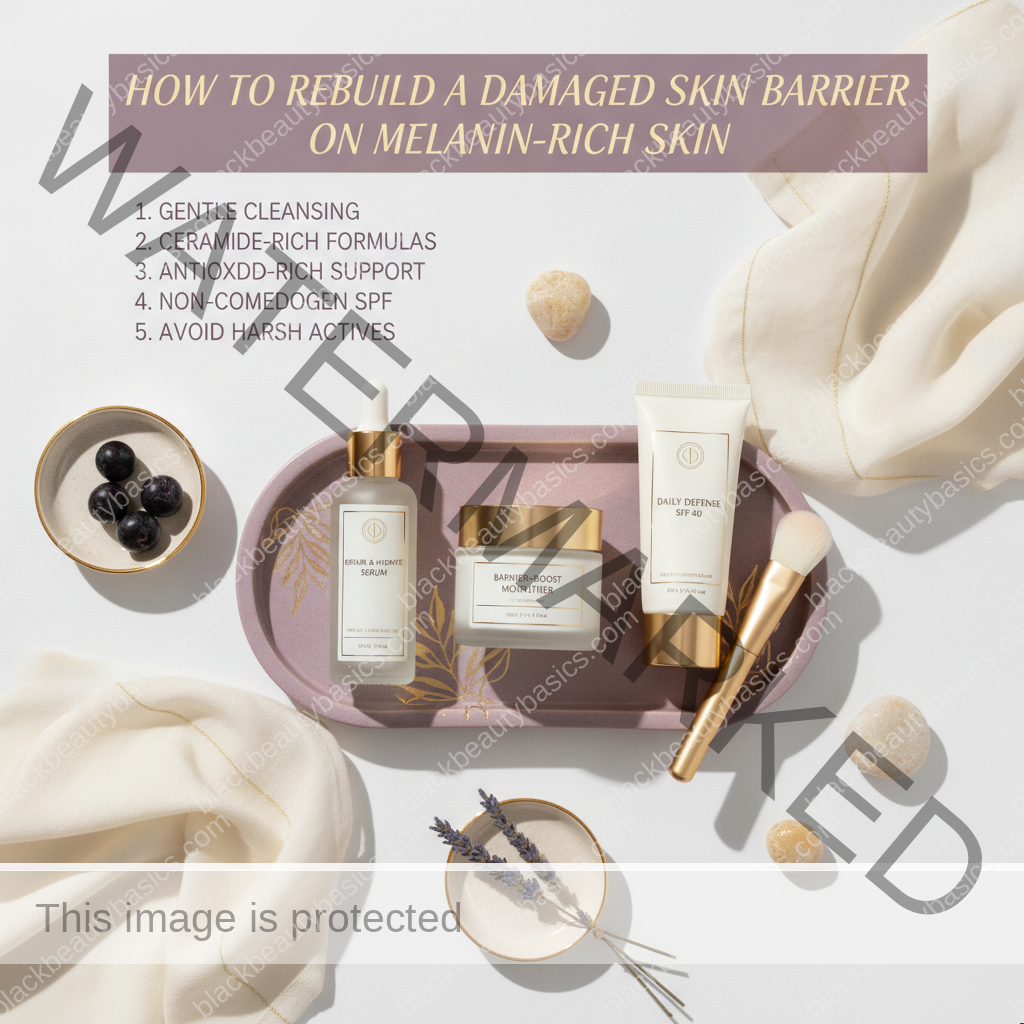
Barrier repair is not glamorous at first. It is not a shelf full of new serums. It is a short routine that protects moisture, lowers irritation, and gives your skin time to stop reacting. For many people, the reset routine is cleanser, moisturizer, sunscreen in the morning, then cleanser and moisturizer at night. If everything burns, even that may need to be simplified for a few days.
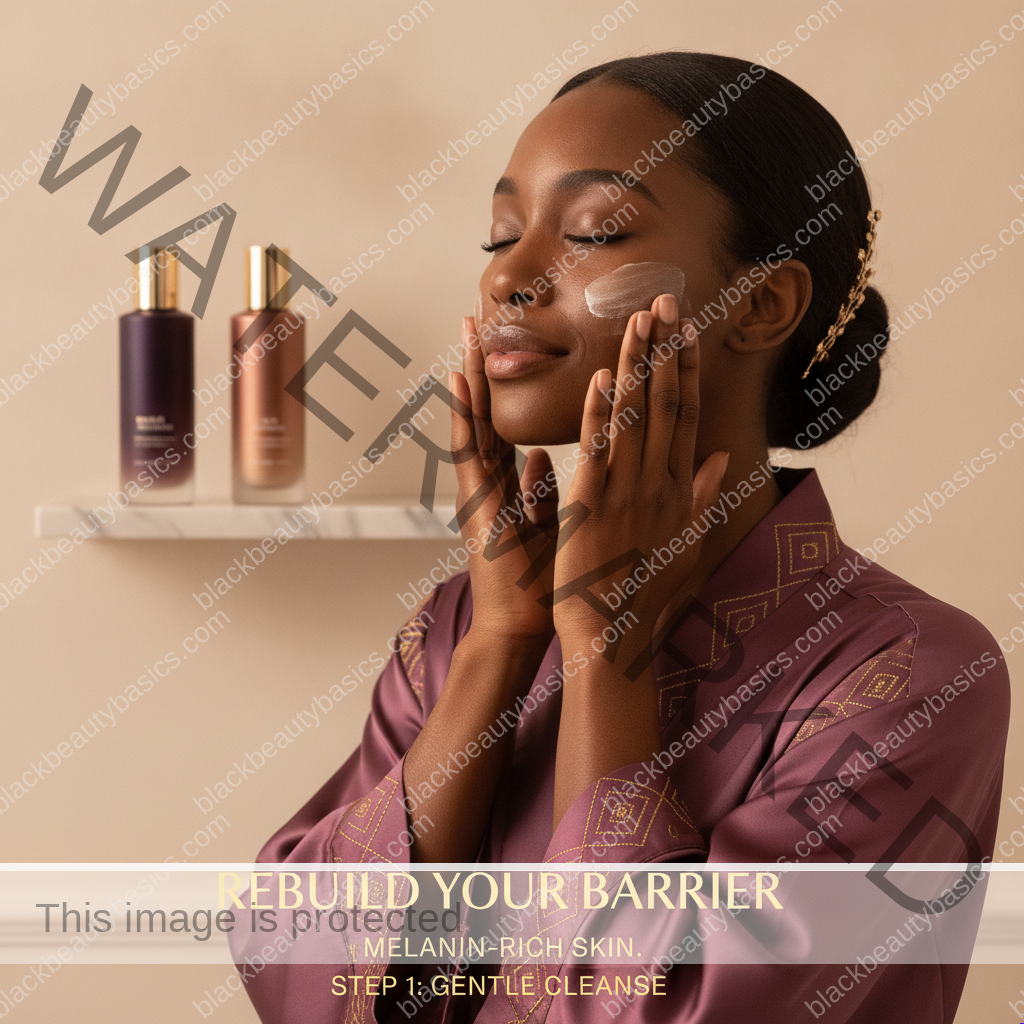
Step 1: Cleanse only as much as your skin can tolerate
Use a mild, non-stripping cleanser once daily at night. In the morning, you may only need a rinse with lukewarm water, especially if your skin wakes up tight. If you wear heavy sunscreen or makeup, cleanse thoroughly but gently at night. Your cleanser should leave your skin feeling clean but not squeaky, stretched, or shiny in a dry way.
Criteria matter more than brand hype. Look for words like gentle, hydrating, creamy, fragrance-free, non-stripping, or barrier-supporting. Avoid anything that makes your face feel polished like glass right after washing. That feeling can be a warning sign, not a compliment.
Example product type: a gentle fragrance-free cleanser can be a helpful starting point. You can explore gentle fragrance-free face cleansers as examples, but choose by criteria and comfort rather than promises.
Step 2: Moisturize like you are sealing comfort in
A good barrier moisturizer does not have to be expensive. It should help your skin feel more comfortable after application and still feel somewhat supported later. Ingredients like glycerin, ceramides, cholesterol, fatty acids, panthenol, squalane, petrolatum, and colloidal oatmeal can be useful. You do not need all of them in one product.
If you have dry patches and oily zones, do not assume you need one heavy layer everywhere. You can use a lighter layer across the face, then add a richer cream only on tight areas. Some people need a cream only at night. Some need a small amount of petrolatum on the driest areas. Some need to stop layering too many serums under moisturizer because the stack itself is causing irritation or pilling. The article on moisturizer layering for dry patches and oily zones goes deeper into that approach.
Example product type: a fragrance-free barrier moisturizer can be useful while your skin is recovering. You can explore fragrance-free barrier repair moisturizers as examples, keeping the final choice tied to your texture preference and tolerance.
Step 3: Use sunscreen, but choose comfort
Sunscreen still matters during barrier repair because UV exposure can worsen discoloration and keep inflammation-looking marks around longer. But if every sunscreen burns, pills, or makes your skin feel trapped, you may need to test gentler formulas and apply them over a moisturizer that cushions the skin. For some people, a mineral or hybrid sunscreen feels better. For others, a modern chemical sunscreen sits more comfortably and leaves less cast. The best sunscreen is the one you can wear without your skin fighting you all day.
If your serum, moisturizer, and SPF keep rolling up, that may be a layering issue, not a personal failure. Use the guide to avoiding pilling with serum, moisturizer, and SPF before replacing every product you own.
Step 4: Give the reset enough time
Many people feel some relief within days, but visible changes can take longer. A reasonable reset window is two to four weeks, depending on how irritated your skin is and what caused the damage. If you need a more structured plan, follow the two-week skincare reset for irritated skin. If your skin burns from almost everything, start with the routine for when everything burns before adding more steps.
Step 5: Reintroduce one thing at a time
Once your skin feels calmer, do not bring everything back at once. Choose one product or ingredient and use it at a low frequency. Give your skin time to respond. If you reintroduce a retinoid, acid, vitamin C, acne treatment, and brightening serum in the same week, you will not know what caused the reaction if your skin flares. A patient routine gives you information. A rushed routine gives you confusion.
What to do if your barrier is not improving
If your skin still burns after simplifying, look for hidden irritants and routine friction. Are you using hot water? Wiping with a rough towel? Applying sunscreen before moisturizer has settled? Using an acne treatment more often than prescribed? Sleeping on fragranced laundry products? Wearing makeup over flaking skin and scrubbing harder at night to remove it? These details can keep irritation going even when the main products look gentle.
If you use prescription acne treatments, do not stop a prescription without guidance from your clinician. Instead, ask how to buffer, reduce frequency, or support your barrier around the treatment. The guide on skincare routines with prescription acne treatments is designed for that support lane.
If hard water seems to make your skin tight, or your dryness changes by city, apartment, season, or shower routine, your environment may be part of the story. Hard water can leave mineral residue that makes skin feel less comfortable, especially when paired with strong cleansers. The hard-water routine at hard water and dry skin for Black women can help you troubleshoot without turning your bathroom into a lab.
If your skin looks dull but feels too sensitive for exfoliation, resist the urge to scrub your way back to glow. Dullness can come from dehydration, inflammation, dryness, or uneven texture. The answer is not always another acid. Sometimes the skin needs moisture, sunscreen, better cleansing, or more time. Use the dull-but-sensitive skin routine if glow is the concern but your skin feels too reactive for your usual brightening steps.
See a board-certified dermatologist, ideally one familiar with skin of color, if you have severe pain, swelling, crusting, oozing, signs of infection, persistent eczema-like patches, sudden widespread reactions, or irritation that does not improve with a simplified routine. BBB can help you organize the routine, but a clinician should evaluate symptoms that may need diagnosis or treatment.
How to measure progress without chasing perfect skin
Barrier repair can be hard to judge because the first improvements are often about comfort, not appearance. Your dark marks may still be visible. Your texture may not look dramatically different. You may still have pores, oil, dry patches, or an occasional breakout. Those things do not mean the reset is failing. A healthier early sign is that water no longer stings, moisturizer feels soothing instead of sharp, tightness takes longer to return, and your face feels less unpredictable from one day to the next.
Choose three simple signals to track once or twice a week: how your skin feels after cleansing, how long it stays comfortable after moisturizing, and whether ordinary products cause burning. You can also note flaking, itchiness, and the number of new irritation-related dark marks. Keep the notes short. The point is to notice direction, not inspect your face into anxiety. Daily photographs under different lighting can make normal variation look like failure, so compare less often and use similar lighting when you do.
Progress may not move in a straight line. Weather, stress, menstrual cycles, sleep, prescription treatments, and a long day in makeup can temporarily change how your skin feels. One uncomfortable day does not erase a week of improvement. Return to the basic routine, check for a clear trigger, and give your skin another quiet stretch before adding something new.
When comfort has been steady for at least two weeks, you can consider one carefully chosen addition. Start with the concern that matters most, introduce only one product, and use it less often than your old routine might have suggested. Keep the cleanser, moisturizer, and sunscreen stable while you test. If stinging, persistent tightness, itching, or fresh irritation returns, pause the new step and go back to the baseline. That is useful information, not a setback.
Most importantly, do not use evenness as the only measure of healing. Melanin-rich skin may hold onto discoloration after the barrier feels stronger. Comfort can improve before pigment does. The calmer barrier is still meaningful progress because it reduces the cycle of inflammation that can create new marks. Your skin does not have to look filtered to prove that gentle care is working.
What to do next
Start by choosing a reset window. For the next two weeks, keep only the steps your skin can tolerate: gentle cleanse, moisturize, sunscreen in the morning, and no unnecessary actives. Put paused products in a separate place so you are not negotiating with them every night. Track comfort, stinging, tightness, flaking, and new dark marks. Do not obsess over your face every hour. Just notice patterns.
If you need a simple decision tool, use what to keep and what to pause during a skin reset. When your skin starts feeling calmer, read how to know when your routine is finally working before you add more products. Your body deserves care, not punishment, and your face does not need to earn gentleness by being perfect first.
If budget is part of the stress, you do not need a luxury routine to repair your barrier. A basic cleanser, moisturizer, and sunscreen can do more than a crowded lineup that makes your skin anxious. The low-budget reset at how to create a low-budget barrier repair routine can help you separate true essentials from nice-to-have extras. If ingredient names feel confusing, the ceramides, glycerin, and petrolatum explainer makes the core barrier ingredients easier to understand.
Frequently asked questions
Is a damaged skin barrier common on melanin-rich skin?
Yes. Barrier damage can happen to anyone, and it is very common when routines include strong actives, frequent exfoliation, harsh cleansers, acne treatments, weather changes, hard water, or constant product switching. On melanin-rich skin, the aftermath may be more visible because irritation can trigger dark marks. That does not mean your skin is weak. It means inflammation and pigment are closely connected, so gentle care matters.
How long does barrier repair take?
Some people feel less stinging or tightness within a few days of simplifying. More noticeable repair often takes two to four weeks, and deeper irritation may take longer. If your skin has been inflamed for months, give it time. The goal is not to rush back to actives. The goal is to rebuild enough comfort that your skin can tolerate helpful treatment later.
Should I stop all actives during a barrier reset?
Usually, yes, for over-the-counter actives like exfoliating acids, retinoids, strong vitamin C, peels, and aggressive spot treatments. Prescription treatments are different. If you use a prescribed acne or eczema medication, ask your clinician how to adjust safely. You may need buffering, fewer nights, or a simpler support routine rather than stopping suddenly.
Can I still treat dark spots while repairing my barrier?
Think of barrier repair as the first step in treating dark spots, not a distraction from it. If your skin is irritated, brightening products may keep triggering the inflammation that makes marks linger. A calm barrier can make future hyperpigmentation treatment more tolerable. During the reset, focus on sunscreen, moisture, and lowering irritation.
What if even moisturizer burns?
Stop layering multiple products and simplify further. Try applying moisturizer to slightly damp skin, use a very bland fragrance-free option, and avoid products with exfoliating acids, fragrance, or strong actives. If plain, gentle products still burn for more than a few days, or if you see swelling, oozing, crusting, or severe pain, it is time to contact a dermatologist.
Is slugging safe for Black skin?
Slugging, or sealing with a thin layer of petrolatum, can help some very dry or compromised skin by reducing water loss. It is not required for everyone, and it may feel too heavy for acne-prone areas. If you try it, use a thin layer over moisturizer, avoid applying it over irritating actives, and stop if it worsens breakouts or discomfort.
When can I exfoliate again?
Wait until your skin feels calm, less tight, less stingy, and more predictable for at least a couple of weeks. Then reintroduce one exfoliating product slowly, not a whole acid routine. Start with a low frequency and watch your skin for delayed irritation. If the goal is glow, remember that comfortable skin already reflects light better than inflamed skin.
Rebuilding a damaged skin barrier is not about being perfect. It is about listening sooner, choosing fewer but better steps, and refusing to treat your skin like it needs to be punished into behaving. Melanin-rich skin can be resilient and sensitive at the same time. Give it the kind of care that honors both truths.
Related next steps
Related posts:
 Signs of a Damaged Skin Barrier on Melanin-Rich Skin: A Guide for Black Women
 Signs Your Skin Barrier Is Healing on Melanin-Rich Skin
 Postpartum Skin Reset: Pigmentation, Acne, and Barrier Repair on Melanin-Rich Skin
 The Five Risk Lenses for Melanin-Rich Skin: PIH, Scarring, Barrier, Inflammation, and Hair
 Ceramide Barrier Repair for Black Women: Why Your Skin Keeps Drying Out
 Understanding Your Skin Barrier for Dark Skin